

Royalty Within the Gables
|
Getting your Trinity Audio player ready...
|
Inside One of the City’s Most Celebrated Structures
There’s something remarkable about walking through the wooden doors of Coral Gables’ Hotel Colonnade for the first time. Depending on the time of day, the sunlight’s glare may darken the windows of the doors, preventing even a preview of the jaw-dropping interior that awaits. Once inside, the five-story rotunda opens before your eyes.
The peach and charcoal marble floor glimmers as if was shined that same morning. Columns, each capped with a tropical birdthemed Corinthian capital, encircle the grand room. A fountain tinkles in the center of the circular space, directly below the astonishing dome ceiling of the rotunda. At its center, a crown-shaped cupola serves as the centerpiece, surrounded by painted blue sky and white clouds, a contrast to the more traditional beiges and creams that make up the rotunda ceiling and walls. The Colonnade’s elegance, which pays homage to Spanish Colonial and Baroque architecture, extends to its exterior. The original roof was built using tiles from Cuba, the same source used by Coral Gables founder George E. Merrick for many of the buildings in his city. The overall design – according to the city’s “Colonnade Building and Surrounding Areas Designation Report” of 1984 – was inspired by Rome’s Castel Sant’Angelo. “One of the possibilities for this inspiration could be that Castel Sant’Angelo was a welcome stop for every pilgrim who visited the Vatican in Rome, just like the Colonnade Building was the welcome center for George Merrick’s dream city,” the report says.
Spearheaded by Phineas Paist, the senior architect of the city, with input from architect Walter De Garmo (behind Miami’s City Hall and the Douglas Entrance) and designer Paul Chalfin (of Vizcaya fame), the construction of the Colonnade was finished in November 1926. It opened originally as the headquarters for the Coral Gables Sales Corporation, of which Merrick was president.
The Colonnade was intended as a selling point for potential land buyers in the new city, extorting Coral Gables’ lavishness at a building cost of almost $1 million dollars (equivalent to $18-plus million today). It featured 40 offices for the original Gables salesmen – a massive upgrade from a much smaller sales office that Merrick previously worked from across the street.

“I think it was more about the strength of having something to found the city,” says Karelia Carbonell, president of the Historic Preservation Association of Coral Gables. “There was just so much growth in those early months that Merrick decided they needed a bigger office, and so this is how the Colonnade came about.”
The building was developed amid the Florida Land Boom in the 1920s, which exploded the greater South Florida population. During this time, 11 cities were born in the region, including Miami Beach, Hollywood, Miami Shores, Hialeah, and Coral Gables. Merrick and his salesmen expected the Colonnade to help accelerate Coral Gables’ real estate boom, which reached $150 million in sales (approximately $2.5 billion in today’s dollars) and $100 million in construction ($1.65 billion today), according to the 1984 designation report. Unfortunately for Merrick (and the rest of South Florida), the period of prosperity came to a screeching halt just two months before the Colonnade’s completion.
Entering a New Era While Preserving History
The Great Miami Hurricane of 1926 destroyed Coral Gables’ economy, as well as its housing stock. As the city stagnated, previous demand to buy property diminished severely, only to be further curtailed with the advent of the Great Depression. Though there was no longer a need for a massive sales center, the Colonnade still found use in the decades that followed. Basketball courts, Florida National Bank, and Columbia Pictures’ movie studio all called the Colonnade home at one point. During World War II, the building was even utilized as a parachute manufacturing facility to assist the Allies’ efforts.
With the Colonnade showing signs of age during the late 1980s, the building was sold to the Omni hotel group to be transformed into a working hotel. But upon hearing about the planned alterations to one of the Gables’ oldest and most popular buildings, the community wasn’t entirely onboard. “There were a lot of protests because the community wanted to preserve the building,” Carbonell says. “And so, there was a compromise [to keep] the original building as it faces Ponce de Leon and then add the hotel in the back.”


The Colonnade up Close: Architectural Details
Architects Spillis Candela and Partners designed the additional structures built behind and around the original rotunda, adding offices, a parking garage, and hotel rooms. Despite these modifications, the spirit and design of the original Colonnade remained intact, including its stately columns and a wraparound veranda that now accommodates three restaurants.
“It’s a blended building because you don’t want to have a historic building and a new, modern building [together],” says Stephanie Kopfstedt, who has been the general manager at Hotel Colonnade since May 2023. “It wouldn’t feel the same. So, they kept everything in the [original] style. That’s why you have the high ceilings and chandeliers, because the whole idea is that it evolves together and it feels like one.” She adds: “I think that’s the uniqueness of the Colonnade. You have historical hotels in Miami [and] you have new hotels. This is the only one which actually blends both nicely together. It’s unique.”
Keeping its famous rotunda was important in not only separating the Colonnade from other hotels but also in paying respect to the city’s founder, whose original sales offices are still a part of the hotel. “[Merrick] planned the City of Coral Gables from the rotunda, so it’s a nice starting [place for] the city,” Kopfstedt says. “The rotunda has grown with the city.”
The Modern Day Colonnade
The new hotel/office complex was unveiled in 1988, around when it also welcomed the city’s first proper bar: the Doc Dammers Bar, named after Edward “Doc” Dammers, the first mayor of Coral Gables and the lead salesman who ballyhooed Merrick’s vision for the city. As a hotel bar with a liquor license, it became the go-to spot for Gableites craving a martini or mojito during a time when few places in the city served liquor.
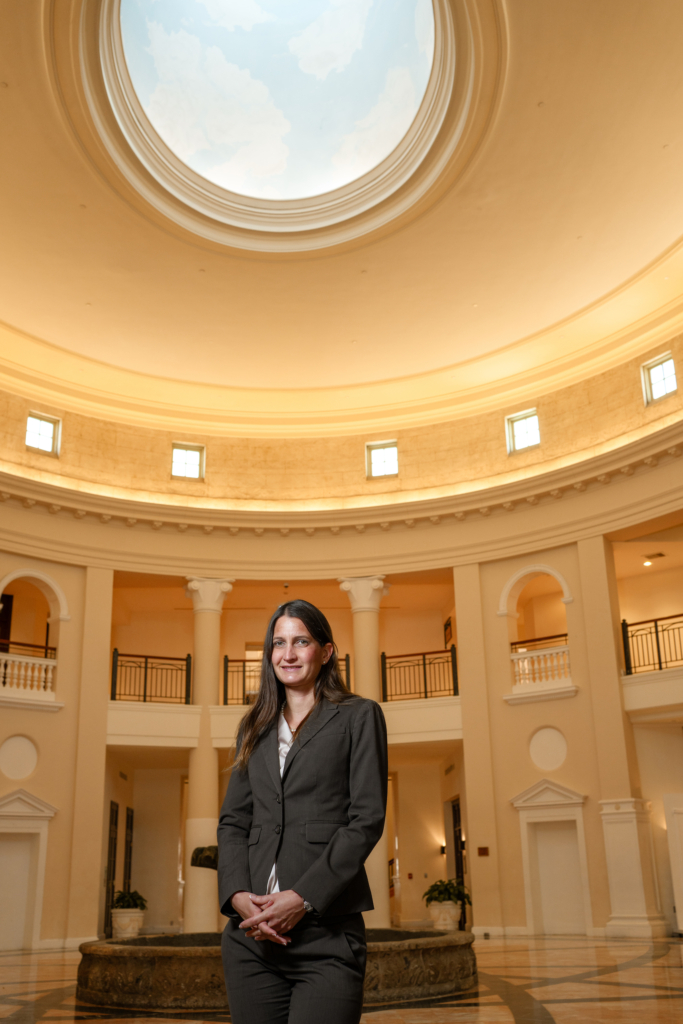
Thanks to its picturesque domed ceiling, grand staircase, stained glass windows, and dramatic lighting, the Colonnade has also turned into a favorite spot for corporate events, elaborate birthday celebrations, and especially weddings – a lot of weddings. “Everyone in Coral Gables has either gotten married in the Colonnade or has attended a wedding here,” Kopfstedt says. “There’s hardly anyone who’s never been to an event at the rotunda. It’s a great, unique connection.
What has helped is the Colonnade’s location, centrally positioned in the heart of downtown Coral Gables at the intersection of Ponce de Leon Boulevard and Miracle Mile. Throughout its 37 years as a hotel, the building has maintained its status as the only hotel directly on the Mile. Guests have the luxury of strollable shops, restaurants, and theaters on the same street. “When you’re here, you don’t need an Uber, you don’t need a taxi, you don’t need a car,” Kopfstedt explains. “You arrive, and offices are only two blocks away. You fall out of the door, and you’re already in a restaurant.”
Since its opening, Hotel Colonnade has operated under several brands. It became The Westin Colonnade in 2007 and held this title until 2016, when the 157-room hotel underwent an $18 million renovation and reopened as part of Marriott’s Autograph Collection. Today, the upstairs offices are also home to Ryder, the global transportation and logistics company that has its logo splashed across the top of the building. (Ryder is one of four Fortune 500 companies with headquarters in the Gables, joining Bacardi, MasTec, and Delmonte Fresh.) For the last two decades, Ryder had been firmly planted in nearby Medley, but with encouragement from city leaders, it made the move in late 2024. About 800 employees call the Coral Gables HQ home.
A Community Tradition
Amazingly, many members of the Colonnade’s first staff remain a part of the hotel to this day. “When people have been working together for so long, they become a part of something,” Kopfstedt says. “Everyone knows everyone. We celebrate everyone’s birthday. We celebrate everyone’s special occasions.”


Left: Completed in 1926 to house Merrick’s sales offices, the Colonnade survived the Great Depression and many changes of use in the decades that followed before it became a hotel.
Right: Today the Colonnade is part of the Marriott hotel brand with major companies such as Ryder occupying its newly renovated office building.
Adding to the hotel’s sense of community, many of the Colonnade’s guests are regular visitors who have been staying at the hotel since its inauguration. “That’s the difference between hotels in Coral Gables and hotels in South Beach,” says Kopfstedt. “You get to know someone, and people feel like coming home.”
The Colonnade’s historic integrity is also maintained by an independent branding team, which performs an evaluation before even the smallest renovations to the Colonnade are done. Though the building is now owned by Crescent Real Estate, which acquired Hotel Colonnade for $63 million in March 2023, alterations to the historic part of the structure must be approved by the city. The idea is to preserve the building’s special, historic identity. “Coral Gables is not cookie-cutter,” Kopfstedt says. “We don’t want to be cookie-cutter. It’s about being different, creating [unique] experiences.”