
The Biltmore: Then & Now
|
Getting your Trinity Audio player ready...
|
A STAYCATION AT THE GABLES’ HISTORIC GEM


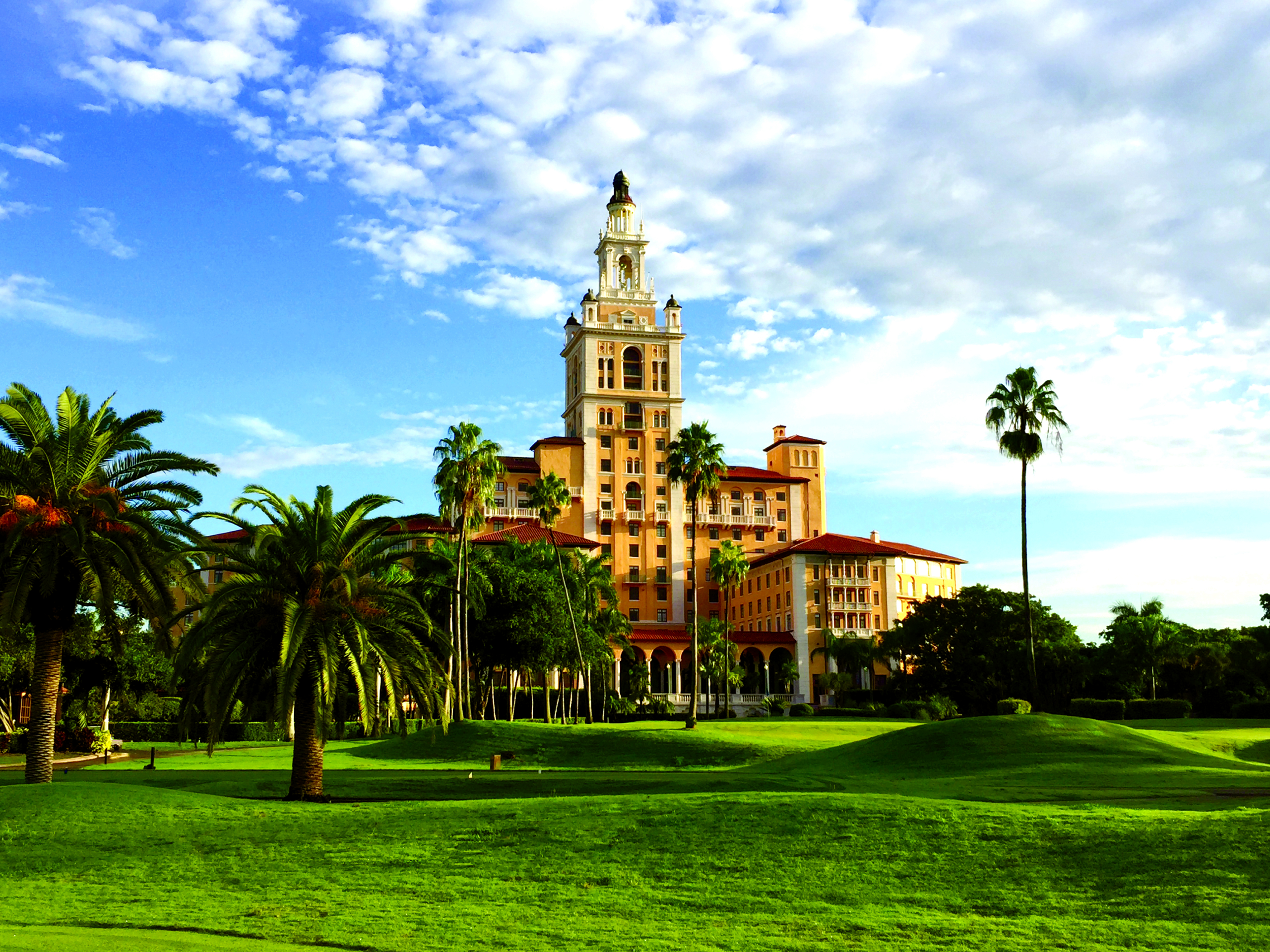
The Biltmore today, the crown jewel of Coral Gables (left); the Biltmore in 1926, still under construction just before it opened (right)
It’s January 1926 and Henry Flagler’s new railroad is packed with people from New York, dressed in their finest for the 36-hour train ride. There are celebrities and socialites, businessmen and politicians, dignitaries and aristocrats, and they’re all going to the same place: George Merrick’s new Biltmore Miami Hotel. The hotel, modeled after a Spanish castle, features an Olympic-size swimming pool, 20 tennis courts, a bell tower inspired by Sevilla’s Giralda Tower, two Donald Ross-designed 18-hole golf courses, Italian gondoliers and gondolas that will carry the soon-to-arrive guests to the nearby Tahiti Beach, and over 400 rooms for the who’s who of America arriving on “the Miami-Biltmore Special” train.
Over the next few months, guests will continue to pack the hotel, which serves as the epicenter of the fledgling City of Coral Gables. Bathing beauties will compete in swimming and fashion shows, alligator wrestlers will delight guests with jaw-dropping stunts, former Secretary of State William Jennings Bryan will sell city lots to prospective homeowners from the lawn, and the famed Johnny Weissmuller, who first played “Tarzan” and won five Olympic gold medals, will even serve as the hotel’s first lifeguard and swimming instructor.
But then comes the Hurricane of 1926, the Great Depres- sion, and World War II – and millionaire owner Henry Latham Doherty’s death. In 1942, the hotel was closed and sold to the U.S. Military for $895,000. George Merrick dies – some say of a broken heart, as his city and its crowning jewel falter. The military eventually transforms the hotel into Pratt General Hospital, a VA hospital for veterans, and the expensive European furnishings are carelessly thrown onto the street. In 1968, a modern hospital is built in Downtown Miami and the once-glorious hotel is abandoned.
The story of the Biltmore Hotel’s saving is a long one we’ll tell another time, but suffice to say, it was saved; first, by Coral Gables Mayor Keith Phillips II in 1973, who wrote to President Nixon to request that the building be returned to the City of Coral Gables; then, by Mayor Dorothy Thomson in 1980, when she cast the deciding vote to save the hotel from the wrecking ball and restore it; and finally, by Seaway Corporation’s Gene Prescott and Bob Kay in 1987, when they took over the hotel’s management from the now-bankrupt Biltmore Corporation and managed to keep the lights on despite Hurricane Andrew’s arrival less than a month before the hotel was scheduled to re-open.


The West Lounge in 1926, decorated in style of the period (top left).
The popular tea party where guests danced outside until the evening (top right).
People taking a relaxing gondola ride along the Coral Gables Waterway in 1926 (bottom left).
The swimming pool remains one of the largest in the country at 23,000-square-feet (bottom right).
Today, the Biltmore is still Coral Gables’ crowning jewel. The swimming pool, once half-filled to provide exercise space for recovering veterans during the hotel’s hospital years, is still one of the largest in the country at over 23,000-square-feet. The golf course – now there is only one, as the other belongs to Riviera Country Club – is home to the top golf school in America, Jim McLean. The gondolas and gondoliers have disappeared, as has Tahiti Beach (now the ritzy Cocoplum neighborhood), but plans to restore the historic Gondola Building are in the works. There are no more mounted fox hunts, though the ancestors of those imported foxes still survive in Coral Gables to this day. And, most importantly, there are still guests – thousands of whom walk through the Biltmore’s doors each year.
On a recent night we spent there, we had dinner at the newly remodeled Fairways restaurant (formerly The 19th Hole) right off the golf course. We delighted in the sunset view, conversing over cocktails and steak as the sky darkened and the final golfers returned in their carts. And, come nightfall, we returned to our room to order dessert and a nightcap, which we enjoyed on our balcony overlooking the 600,000-gallon pool, now bereft of tourists.
The magic of the Biltmore is not just in its Roaring 20s aesthetic, but in its enduring spirit. It has survived two major hurricanes, 17 years of abandonment, a $100 million restoration, and myriad openings and closings. Walking its grounds, you can see history come alive, from the old diving board that now functions as a waterfall, to the coral rock fountain outside the pool, made from real coral (now illegal to harvest in Florida). In the ballrooms, the balconies where jazz musicians once played for their uninhibited guests still stand. In the lobby, mahogany cages that hold chirping finches replicate the old chandeliers hanging overhead. And if you look up, you’ll see where the hotel has attempted to replicate the night sky – the same stars guests would’ve tilted their heads to see in 1926.
THE BILTMORE HOTEL
1200 ANASTASIA AVE
855.311.6903