
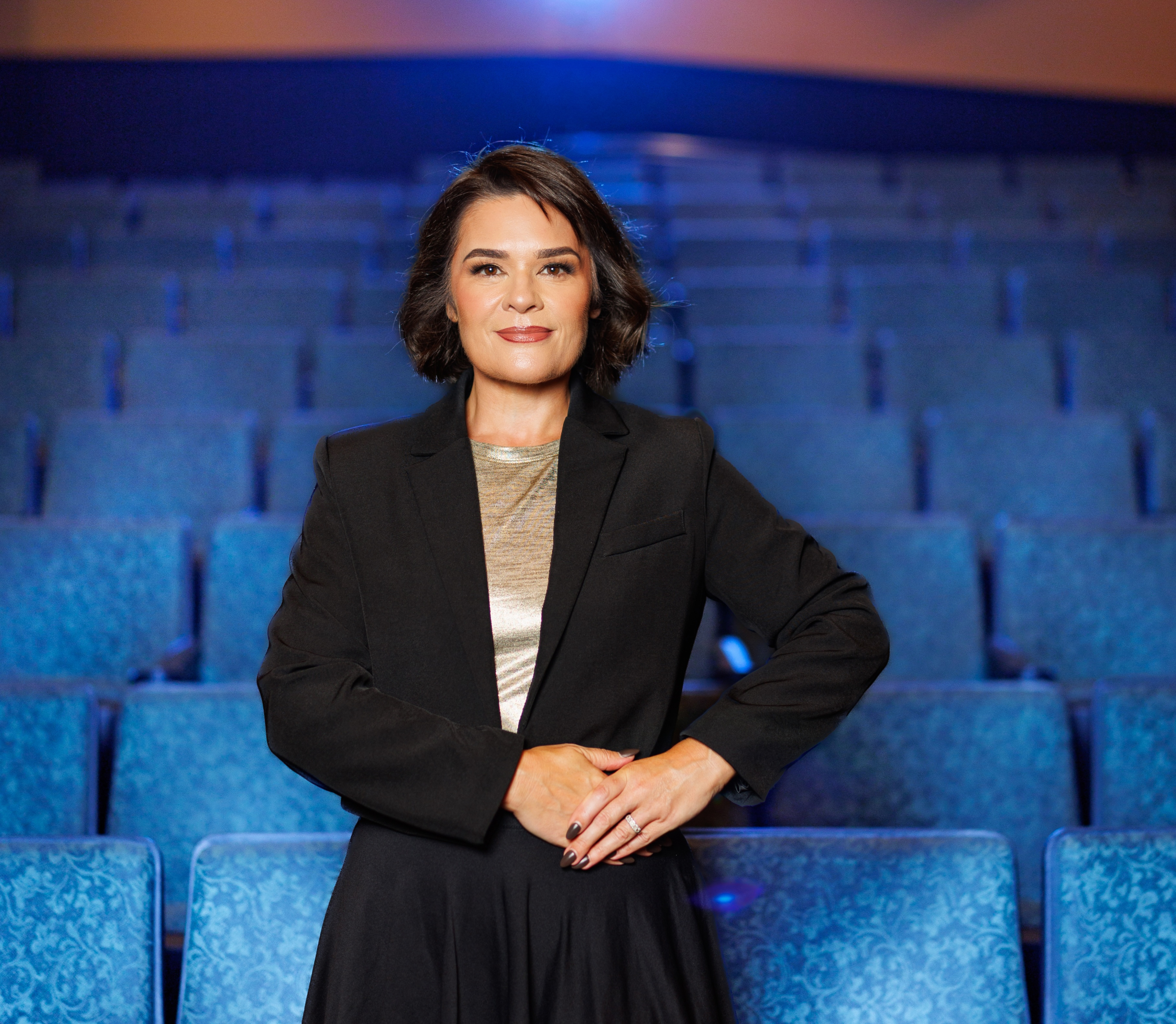
MOE TOWN
|
Getting your Trinity Audio player ready...
|
How Brenda Moe has created the soul of the Gables Art Cinema
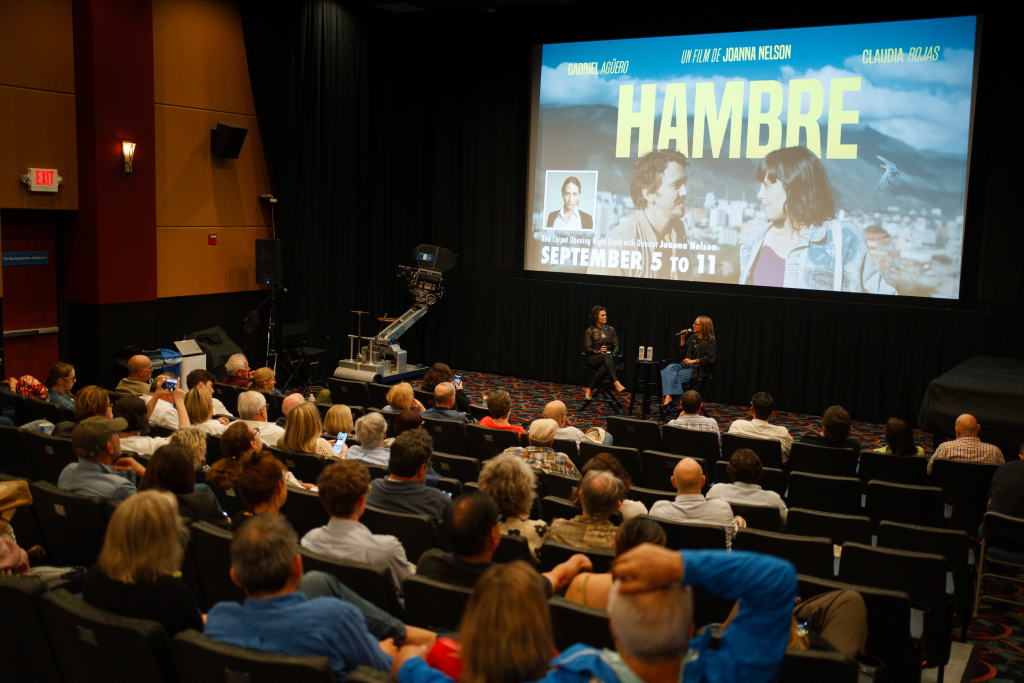
It is a Friday night in September and Brenda Moe is holding a red-carpet event at the Art Cinema on Aragon Avenue. The occasion is the first U.S. screening of the Venezuelan movie “Hambre” – the Spanish word for “hunger”– a movie about the travails of a young couple living under the Maduro dictatorship in Caracas. A small crowd has gathered outside, filing slowly past a buffet of empanadas and tequeños, courtesy of local Venezuelan eatery Punto Criollo.
For Moe, executive director and head of programming for the Art Cinema, this is just the kind of event that has helped the local movie house flourish. Before the film begins, Moe thanks the packed audience for attending and highlights the work the cinema does to promote emerging and foreign filmmakers – along with bringing classics and first-run movies to the screen.
“We are celebrating our 15th year this year as Coral Gables’ bedrock of culture,” she tells the audience. “This year, we hit 2,500 members, which is a huge feat for an organization of this size. We are so proud to serve our community.”
“People Do Pay Attention To The Work That We Do, Because We’re One Of The Highest Performing Single-Screen Cinemas…”
Brenda Moe Holding A Q&A With “Hambre” Director Joanna Cristina Nelson
After the movie, Moe will conduct a Q&A with Joanna Cristina Nelson, the movie’s Venezuelan director. “I hope this screening, what it does is raise awareness with theaters across the country,” says Moe. “People do pay attention to the work that we do, because we’re one of the highest performing single-screen cinemas. This is why, at the beginning of this year, we had Pedro Almodovar’s new film exclusively for the first week in the state of Florida.”
Getting those sorts of exclusives, along with permission to screen first-run films for short periods (rather than being required to run new movies for dozens of times) is the result of years of work Moe has done with film distributors. These are relationships that she has nurtured over not just her eight years with the Cinema, but over two decades of working in the industry.
FROM FARM TO FILM
Despite her current dedication to the Art Cinema, and her transformation of the movie house from precarious nonprofit into one of South Florida’s most dynamic cultural venues, Moe’s path in the world of film was anything but direct. Raised on a family farm in Grays Harbor County, Washington, she spent her childhood imagining life beyond her small town. “I used to send away for subway maps from New York and Chicago,” she says. “I just dreamed of cities.”
She eventually left for Evergreen State College, then transferred to Harvard to study human biology. But even in Cambridge, she felt restless. “I realized I needed to experience the world, not just study it,” she says. So, after two years at Harvard, Moe moved to New York City.
A chance connection led her to Scenarios USA, a nonprofit where Hollywood directors collaborated with high school students to turn their stories into films. “I was drawn to the mission more than the movies,” she admitted. “It felt like social-service work with a creative output.”
Nonetheless, it was at Scenarios USA where “I caught the cinema bug,” she says. She was assigned to produce a documentary on the nonprofit itself, and, from there, hired to work on other documentaries and short films. Over the next decade, Moe’s résumé expanded in unpredictable ways, from producing music videos for Rick Ross and P. Diddy, to running an online short-film platform backed by Robert Duvall, to working on a commercial with Jude Law in the Bahamas. “I was making films in New York City, in the Rio Grande Valley in Texas, in Chicago, and in Orange County, working with Hollywood filmmakers,” she says.
Scenarios USA also brought Moe to Miami in 2002 to produce a short film with director David Frankel. The project introduced her to the city’s film community and, eventually, to Steven Krams, who would eventually create the nonprofit that was to run the Gables Art Cinema.
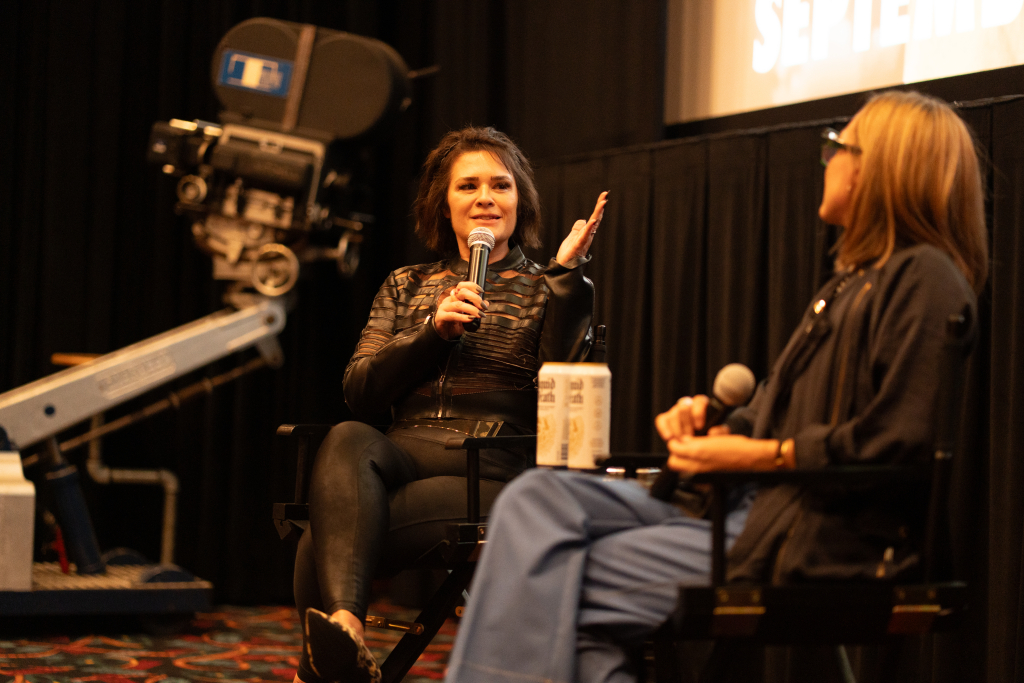
“I Want Gables Art Cinema To Be Where People Come To Connect. Not Just With Movies, But With Each Other…”
Brenda Moe. Executive Director At Gables Art Cinema
That was eight years later, when then-mayor Don Slesnick led the effort to create a cultural core in the downtown, with the Art Cinema, the Miracle Theatre, Coral Gables Museum, and Books & Books combining to attract residents and visitors alike. He and like-minded members of the City Commission wanted a local film house that would provide more than just commercial flicks. They wanted foreign films, Spanish language films, indies, classics, children’s programming, and more. And they got it all, with a small, 140-seat art film house that would cater to the tastes of Gables residents, right in the center of the walkable downtown.
“It’s amazing that the things we tried to predict, and wanted, have been done,” says Slesnick. “That is partly thanks to those who ran it from the start – Steven Krams, the members of the board members, and Brenda, who is the latest and greatest. Obviously, she is leading the charge to produce the events and everything else.
Moe knew Krams because of his company Continental Film and Digital Lab. Her New York nonprofit “only shot on film, so we processed and transferred at his lab every time we shot in Florida,” she says. During one trip to Miami, Moe read an article about Coral Gables asking Krams to submit a proposal to run the Art Cinema. At the time, Moe was helping the Miami Short Film Festival, and asked Krams to be on the jury. He, in turn, asked her to help with board development, fundraising, communications, and finding the first director at the cinema. “The building wasn’t even built yet,” she says. “But it was great. I loved it, it was such an exciting project.”
With the Cinema up and running, Moe left to take a job with a company called Open Film, an online platform for short films owned by a Russian, which sent her to Moscow and Latvia and Beverly Hills, where they had an office. When Open Film was sold in 2013, she got a call from Krams asking her to come back to Miami to produce a children’s film festival. When that finished, he hired her to start a planetarium “vertical” within one of his companies, and to produce content for planetariums around the U.S. and China. “It was a fascinating job,” she says.
Finally, in 2016, Krams called her to say the Art Cinema needed an executive in charge. So, she started as administrative director, got married, bought a house, and became pregnant. “The year 2017 was busy and incredible. My son was born early – I was at the cinema when my water broke. I drove myself to the hospital,” she says. The following year she was named co-executive director, and, in 2021 – after a headhunter from another organization offered her a big raise – she was finally named executive director. On her first day in that role, she secured a $150,000 donation – the largest individual gift in the Cinema’s history at the time.
REINVENTING PROGRAMMING
Almost immediately, Moe faced her boldest test: programming. When longtime curator Nat Chediak retired from the cinema, Moe made the unorthodox choice to take on programming herself. “I’d been convinced that programming was something mystical,” she says. “But really, it’s about relationships and vision. And it’s about listening to your audience.”
She opened doors that had long been closed – inviting local organizations to co-curate, sending staff to international festivals, and experimenting with more eclectic lineups. The results were immediate: stronger community ties, wider variety, and a renewed sense of identity for the Cinema.
“In the past, we were hoping one film would carry us through the week,” she says. “Now, we create variety. We take risks. And our audience responds.”


A Saturday Sampler At The Art Cinema. Sat., Sep. 20
1:30 pm. Water Lilies Of Monet
3:30 pm. Don Hertzfeldt Presents Animation Mixtape
5:45 pm. Downton Abbey: The Grand Finale
9 pm. Giant, Starring James Dean
Since then, Moe’s innovations have redefined what Gables Art Cinema offers:
Reviving Celluloid. In 2023, the theater prioritized showing movies on film stock, including “Oppenheimer” in 70mm for 56 screenings and “The Wizard of Oz” on 35mm. “Watching film on film reminds people this experience is unique,” Moe says. “It’s something you can’t stream.”
Direct Filmmaker Partnerships. As distribution models shift, Moe has worked with filmmakers releasing their own work. “It doesn’t always hit,” she admits, “but when it does, it connects audiences with voices they might never hear otherwise.”
Community Engagement. Moe has expanded filmmaker Q&As and leaned on programs like “Movies We Love,” curated by Krams and Books & Books founder Mitchell Kaplan, which mixes classics and contemporary picks.
“She’s taken the cinema from being a niche theater to being a cultural gathering place,” Kaplan says. “It’s about more than movies – it’s about conversation.”
Board Director Marlin Ebbert says Moe’s programming and ability to engage audiences have made the crucial difference. For the screening of Downton Abbey in September, “we had a tea party on a Sunday. It sold out the Tuesday before, all 141 seats.” The diversity of films is also paramount. “We really show something for everyone,” Ebbert continues. “It’s amazing to have a single screen and show five different films [on a single Saturday]. Sometimes a family film will start the day at 11 am, and it carries on from there. I’lI leave a 7:30 pm film that gets out at 9, and there will be line for a 10 pm film I’ve never heard of, or an old cult film.”
The next milestone is a second screen, a project Moe, Krams, and the board has been working on for years, pushing into the space next door (currently a patio furniture store). It will also mean more space for staff, and a real concession area. It is now so close that Moe is already preparing audiences for programming as if it exists. “The expansion gives us breathing room,” she says. “We can run two independent films at once instead of choosing between them.”
Moe also sees the cinema as a bridge across generations. “When a family comes to see ‘The Wizard of Oz’ on 35mm, and the grandparents are crying while the kids are wide-eyed – that’s what keeps me going,” she says. “Those shared moments can only happen in a theater like this.”
In the end, Moe’s leadership has been shaped as much by personal experience as professional training. Her son Wilder, once nicknamed the “office baby,” still drops by the theater. Her husband, an e-commerce executive, is her sounding board. And her own winding path – from rural Washington to Harvard to New York nonprofits – has given her a wide lens on what film can mean. “I came into this work through social service,” she says. “For me, cinema is about empathy. It’s about stepping into someone else’s story.”
That philosophy has become the Cinema’s north star. “I want Gables Art Cinema to be where people come to connect,” she says. “Not just with movies, but with each other.” – Additional reporting by Luke Chaney