

The Relentless Banker
|
Getting your Trinity Audio player ready...
|
Pondering the Next Challenge: Jorge Gonzalez, CEO of City National Bank

How Jorge Gonzalez Turned City National Bank, Now Coral Gables’ No. 2 Employer, Into a Financial Powerhouse
It is a Monday evening in May, and some two dozen senior staff members and VIP guests have assembled in a downstairs conference room at City National Bank’s executive offices on LeJeune Road, a few blocks south of Miracle Mile. They are waiting for CEO Jorge Gonzalez, who soon strides into the room with the kind of presence that instantly changes the atmosphere. His energy is immediate and electric, confident without being theatrical.
This evening Gonzalez is interviewing – more accurately, chatting with – Nico Echavarria, one of the hottest young golfers on the PGA Tour, fresh off a victory at the Cognizant Classic in Palm Beach Gardens. Echavarria has just signed on as a brand ambassador for City National Bank, and Gonzalez wants to officially welcome him “to the family.” The next hour unfolds with Gonzalez in perfect form: smiling frequently, teasing his guest, firing off quick jokes, then pivoting seamlessly into serious questions about discipline, resilience, and what separates winners from everyone else.
“The last person I interviewed was Jamie Dimon,” Gonzalez jokes to the room, referring to the billionaire chairman and CEO of JPMorgan Chase & Co., who he interviewed at the Kaseya Center for the America Business Forum. “So this is a smooth transition to you.” The audience laughs and Echavarria grins. Gonzalez leans forward and gets to the heart of the matter. “When it’s Sunday afternoon and the pressure is building,” he asks the golfer, “what allows you to stay mentally focused?”
The question could just as easily apply to Gonzalez himself. Winning is what Jorge Gonzalez is about, but not in the simplistic chest-thumping sense usually associated with corporate success. Winning, to him, means preparation and staying calm when everyone else is panicking. It means finding opportunity in moments when others see only danger. And it depends on being able to connect with other people.
That ability to understand both numbers and human beings has helped Gonzalez transform City National Bank from a relatively modest institution with less than $3 billion in assets into one of Florida’s most formidable financial organizations, now approaching $30 billion in assets after 17 years under his leadership.
It is a remarkable trajectory by any standard, especially because most of that growth has been organic. Yet those who know him best insist the numbers alone fail to capture what makes him exceptional. “He understands the critical role that banks play in communities,” says Jaret Davis, managing shareholder of Greenberg Traurig and a member of City National Bank’s board. “And he’s phenomenal at cultivating talent.”
Leonard Abess, the legendary former owner of City National Bank who recruited Gonzalez to run the institution after selling it in 2008, puts it even more directly. “Banking is in his blood,” Abess says. “He was born to do this.”

Jorge Gonzalez (Shown Interviewing the Billionaire Chairman and CEO of JPMorgan Chase & Co.)
A Miami Story
To understand Jorge Gonzalez, you have to understand Miami. Not the glossy international capital of luxury condos, Formula One races, and hedge funds that have relocated to the city en masse, but the older Miami, the rougher, scrappier, immigrant city that existed before Brickell became a canyon of glass towers.
Gonzalez grew up in Little Havana, near the old Orange Bowl stadium. His mother still lives in the same house where she brought him home as a baby more than 60 years ago. “She’s been there 61 or 62 years,” Gonzalez says. “And now I get to take my kids back to the house I grew up in.”
His parents came from Cuba and, like so many other immigrants who fled after Castro took over, rebuilt their lives in the United States through hard work and sacrifice. His father, Gonzalez says often, shaped his entire philosophy about work ethic, discipline and surrounding yourself with good people.
His mother, ironically enough, worked for City National Bank long before her son ever imagined leading it. Years later, after Gonzalez accepted the top position, he called her with the news. “I said, ‘You’re not going to believe this. Remember that institution you used to talk about all the time? I’m the new president.’ We both cried like babies.”
Growing up in Miami during the 1970s and 1980s also meant growing up amid constant change. Gonzalez remembers the Mc- Duffie riots, the Mariel boatlift, and the transformation of South Beach from urban decay into a global destination. “I feel like I owe this city a lot,” he says. “The diversity of the city has really allowed me to become who I am today.”
That environment also sharpened his instincts. “The more change you see,” he says, “the more it prepares you from a business standpoint to anticipate change or react to change.” Those lessons would later prove invaluable.
The Banker Who Almost Became a Lawyer
Gonzalez did not initially plan on becoming a banker. As a student at Florida International University, where he majored in finance and international business, he intended to go to law school. But during an internship at a German bank on Brickell Avenue, he spent time around corporate attorneys and quickly realized that the reality of legal work differed dramatically from the glamorous courtroom dramas he had imagined. “I thought law was what I saw on TV,” he says. “These great litigators in front of juries. But 99 percent of it was reading contracts and negotiations. I said, ‘No bueno.’” Instead, he discovered banking.
What appealed to him was not simply finance, but problem-solving. Banking sat at the intersection of business strategy, economics, relationships, and community development. He joined Southeast Bank, which later became First Union, then Wachovia and eventually WellsFargo through a series of mergers. Gonzalez stayed with the organization for more than two decades, rising steadily through the ranks.
Unlike many executives who specialize narrowly, Gonzalez gained exposure to virtually every aspect of banking. He worked in commercial banking, small business lending, credit underwriting, asset recovery, and retail banking. Perhaps most importantly, he spent time working through bad loans. “You never understand banking unless you understand what happens when things go wrong,” he says, an experience that would shape his entire leadership philosophy. “Sometimes you learn more during bad times than during good times.”
By the time he left Wachovia, Gonzalez was running the Florida market for one of the nation’s largest banks. He had security, prestige and influence, but he also saw an opportunity.
Building the Big Bank Alternative


Expanding North: Gonzalez at the New Orlando City National Bank Offices and, Left, Speaking in Orlando
In 2008, in the middle of the financial crisis, Gonzalez made what many would have considered a risky move: He left the giant-bank world for City National Bank. At the time, CNB was far smaller and less prominent than the banking giants dominating the market, but Gonzalez saw something others missed. “The market was craving more relationship banking,” he says. “Clients couldn’t access anybody who could make decisions at the large institutions.”
His vision was deceptively simple: create a bank with the technology, sophistication and product capabilities of a large, national bank, but with the responsiveness and intimacy of a community institution. In other words, a high-touch bank with big-bank capabilities. That concept became the defining strategy of City National Bank.
“We see ourselves as the big-bank alternative,” says Eddie Dominguez, a longtime executive at the bank. “We can deliver the same products and services, but with relationships.”
Leonard Abess, meanwhile, had spent years quietly searching for someone who could take City National to another level. When he met Gonzalez, he recognized immediately that he was that person. “I knew exactly who needed to come in here and take this bank over,” Abess says, bringing in Gonzalez as president in 2008.
At the end of that year Abess sold his 83% stake in City National to the Spanish banking group Caja Madrid (which later became Bankia) for $927 million, famously giving away $60 million of his personal proceeds to current and former employees. But before stepping aside, he groomed Gonzalez to become CEO.
Then the financial world exploded. Lehman Brothers collapsed, the Great Recession intensified, and the Spanish owners themselves became engulfed in Europe’s banking crisis. Gonzalez suddenly found himself navigating economic chaos while simultaneously trying to rebuild and reposition the bank.
“He didn’t just hop into a finely tuned race car,” Abess says. “He had to deal with the 2008 crash, a struggling owner, regulatory challenges, the sale of the bank and a changing market – all while building the organization.” Yet Gonzalez, in what may be his defining characteristic, never panicked.
Turning Crisis Into Opportunity
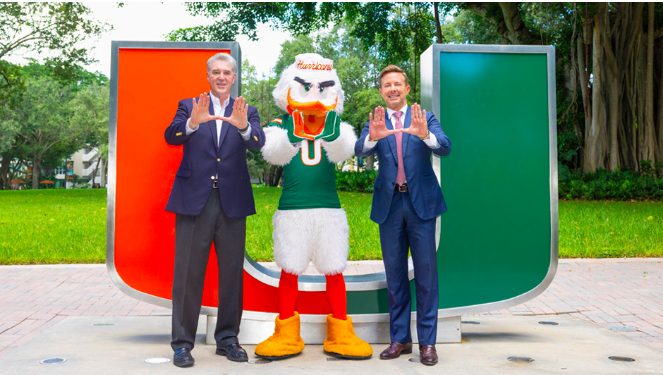
Jorge Gonzalez and Dan Radakovich, Athletic Director of the University of Miami
Almost every executive claims to perform well under pressure, but few have a track record like Gonzalez. After stabilizing CNB in the wake of the 2008-2009 U.S. financial crisis, its parent bank in Spain went through its own crisis and was forced to sell its foreign assets. Bankia announced a sale agreement in 2013 to Chile’s Bci but then took two years to close the sale due to regulatory hurdles. While it turned out to be a great deal for CNB – providing capital resources while granting autonomy – keeping the bank focused and growing during those two years took a steady hand.
That challenge paled in comparison, however, to the Covid pandemic, which threatened to close down the U.S. economy. While many banks hesitated, Gonzalez was determined to get ahead of the problem. Rather than viewing the pandemic solely as a threat, Gonzalez viewed it as a chance for the bank to demonstrate leadership. “We focused on the solution,” he says. “Not the problem.” City National aggressively embraced the federal PPP lending program designed to keep businesses alive even before the regulations were finalized. “We were building the airplane while we were flying it,” recalls Dominguez.
Rules changed daily, systems had to be built from scratch, and employees worked around the clock from home. Gonzalez created virtual “war rooms” with employees collaborating late into the night, processing forms and applications and working through strategies. “I remember conference calls at three or four in the morning,” Gonzalez says. “And everybody was all in.”
City National ultimately became one of the nation’s leading PPP lenders, and its top lender in the Federal Reserve’s Main Street Lending Program, distributing some $4 billion in funds, which helped preserve an estimated 300,000 jobs. While other banks shrank during the Covid crisis, City National actually grew, making it to the front page of the Wall Street Journal as the bank in Miami leading the bailout program for businesses.
The same pattern repeated itself during the regional banking turmoil that followed the sharp rise in interest rates in 2023. As institutions like Silicon Valley Bank and First Republic collapsed, fear spread rapidly through the financial system.
Many banks went silent, while Gonzalez did the opposite. He ordered senior executives to personally call thousands of clients, first anyone with at least a million dollars with the bank. “That was round one. Then we lowered the bar, and we ended up doing this bank wide, with an effort to call all the depositors of the bank,” says Dominguez. “We were basically saying, ‘I’m reaching out because of what’s happening in the environment and want to reassure you.’ Our clients were thanking us. They hadn’t heard from any other banks because no one else wanted to even talk about it.”
The effort reassured depositors. While many banks lost money, City National gained deposits. “He doesn’t hide when times are tough,” says Davis. “That’s when he becomes more visible.” And that willingness to confront problems head-on has become part of the bank’s culture.
Through every moment of difficulty, emerges a better, more efficient, stronger organization,” says Joe Nader, who oversees private banking and wealth management at CNB. “There’s just nothing like that cultural feeling inside an organization when you’re able to persevere during a very difficult time. It changes everything about the organization. It brings people much more closely together. You align on a singular mission and purpose, and you just execute with so much pride and meaningfulness that it becomes part of the organization.”
Culture as Competitive Advantage
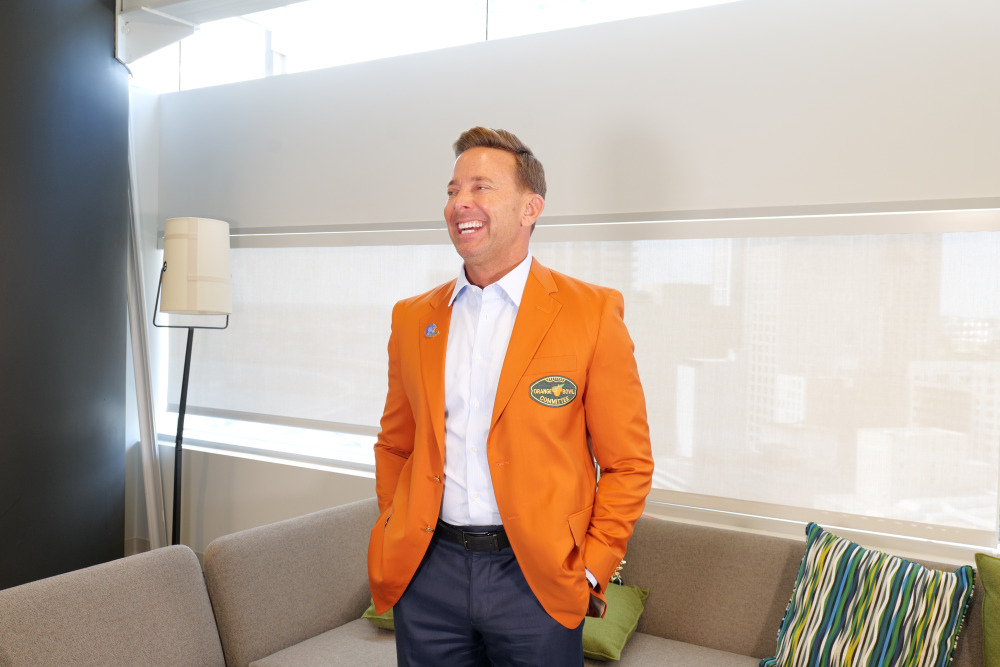
Jaret Davis, a Member of City National Bank’s Board, Talking of Gonzalez Serving on Nonprofit Boards and the Bank Supporting the Local Community
Ask Gonzalez what he is most proud of and he does not begin with asset growth. He talks about people, specifically the culture inside the organization. “You can have great culture and mediocre strategy and still do well,” he says. “But you can have great strategy and no culture, and you’re probably not going to succeed.”
That emphasis explains much about City National’s growth. Executives repeatedly describe the institution less as a corporation and more as a mission-driven team. “He cultivates talent better than almost anyone,” Davis says. “There are bankers throughout the community who say, ‘I cut my teeth with Jorge.’”
That development mentality traces back partly to Gonzalez’s own mentors. One of the most influential was Carlos Migoya, the future CEO of the Jackson Health System, under whom Gonzalez worked during his First Union years. Like Migoya, Gonzalez believes organizations succeed when leaders invest deeply in people.
The bank’s internship program reflects that philosophy. Each summer, City National brings dozens of college students into the organization to expose them to the realities of banking. Gonzalez believes too many young people choose careers without truly understanding them. “You have to go see what these jobs really look like,” he says.
Internally, he emphasizes accessibility and accountability. Unlike giant financial institutions where decision-making disappears into layers of bureaucracy, City National prides itself on responsiveness. Clients can reach senior leadership, and that matters. “When things get difficult, people want to know somebody’s there,” Gonzalez says.
One of Gonzalez’s most consequential decisions has been resisting the traditional retail-branch arms race. While many banks expanded aggressively through sprawling branch networks, City National chose a different path. A bank of City National’s size should have hundreds of branches. CNB has just 30.
“We replace brick and mortar with people,” Gonzalez says. Technology handles routine transactions, while relationship managers handle clients. “Our model is about going to visit clients where they are,” he says. That approach allows the bank to invest more heavily in talent and technology instead of real estate. It also reinforces the institution’s identity as a relationship bank rather than a transactional one.
The strategy has proven especially effective among high-networth clients and businesses seeking more personalized service. Nader says Gonzalez recognized early that affluent clients increasingly wanted integrated financial solutions, brought to them in a personalized way. “He had the vision to bring banking, lending, wealth management and trust services together,” Nader says. The result has been rapid growth in private banking and wealth management alongside the broader expansion of the bank.
Banking as Community Building
Under Gonzalez, City National has also become deeply embedded in South Florida’s civic and philanthropic fabric, and especially in Coral Gables. “I always felt Coral Gables was becoming the center of South Florida,” he says, one reason he lives here and moved the executive leadership team to a company-owned building on LeJeune in 2019. This month he is doubling down on that move, relocating all 900 employees from downtown Miami to Coral Gables, occupying what was formerly the Bacardi building.
In the same way that Southeast Bank became the model of what it means to support the community, City National has been actively sponsoring events for the Coral Gables Chamber of Commerce and partnering with the Coral Gables Community Foundation. The bank is now also the official bank of the University of Miami, the city’s largest employer (City National is now the second largest employer).
Manny Kadre, chairman of the university’s board of trustees, says the partnership reflects shared values. “Whenever you stand two strong brands together, they both become stronger,” Kadre says, noting that the relationship goes beyond sponsorships. City National executives mentor students and student-athletes on financial literacy, investing and wealth management. “Jorge took it seriously,” Kadre says. “Not just being the bank, but helping students understand their financial lives.”
Gonzalez also serves on nonprofit boards throughout South Florida. “He understands banks are part of the community ecosystem,” Davis says. “Not separate from it.”
The Human Side of Leadership
For all his intensity, Gonzalez remains surprisingly approachable. People who work with him describe a leader who combines relentless standards with humor and warmth. “He loves picking on people,” Dominguez says, laughing. “He’ll tell you, ‘If I’m not picking on you, that’s when you should worry.’”
That personality surfaced repeatedly during his conversation with golfer Nico Echavarria. At one point, Gonzalez joked about the bank’s uncanny timing in signing athletes and organizations shortly before major successes. City National partnered with Inter Miami before Lionel Messi arrived. It became the official bank of the University of Miami before the Hurricanes reached the national championship game. The bank signed Echavarria days before his PGA victory.“We should start getting paid for this,” Gonzalez joked.
But beneath the humor was something more revealing. Throughout the evening, Gonzalez kept returning to the same themes: preparation, discipline, composure and resilience. He listened intently as Echavarria described breathing techniques for handling pressure and the importance of staying present during critical moments.
The parallels between championship golf and banking were obvious. “You can’t be thinking about the outcome,” Echavarria said. “You have to focus on executing the shot in front of you.” Gonzalez nodded. That mindset mirrors how he approaches business. And that strategy has worked.