
Illuminating Zelda: The Light and Fire of a Flapper’s Life
|
Getting your Trinity Audio player ready...
|
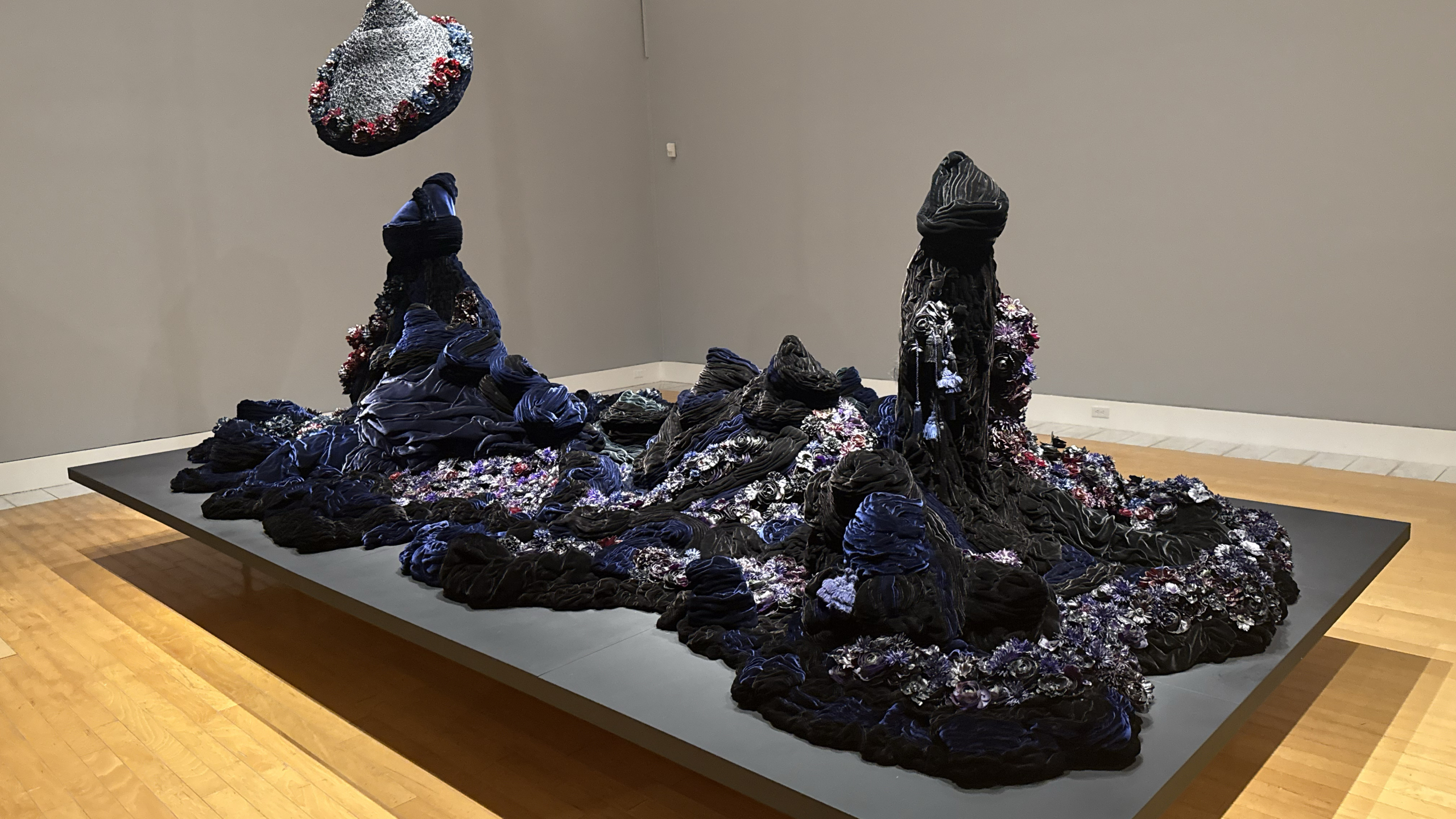
In the Lowe Art Museum, at Petah Coyne’s exhibition, “How Much a Heart Can Hold,” two works caught my attention: “Untitled #1378 (Zelda Fitzgerald)” and “Untitled #1379 (The Doctor’s Wife).” I knew little about Zelda, and Coyne’s excessive ultrabaroque installations with intriguing titles triggered my curiosity. I did some reading keeping these works in mind, for I found in them contrasting emotional climates, both pointing to a life shaped by brilliance, desire, volatility, and disaster.
Zelda Fitzgerald’s story is complex. Thus, Coyne’s massive body of work on her is, too. The artist transforms an encyclopedic list of materials (wax, silk flowers, velvet, pearls, human hair, chains, wire, tassels, bolts, shards of metal) into meditations on luminosity and ruin, the irreconcilable forces that defined Zelda’s creative and psychological world. Either in the contained box or in the sprawling landscape, viewers are forced to look at the artworks from a distance while, at the same time, falling for the lure of their materiality.
For an artist who experiments so meticulously with materials, every ingredient adds meaning, yet sometimes accumulation trumps detail. “Untitled #1378 (Zelda Fitzgerald)” reads like a chamber of light, an interior cosmos where wax-dipped flowers and pearl-tipped pins shimmer with the fragile promise of portraiture revealed in its title. It evokes Zelda’s incandescent writing, painting, dancing – creative pursuits too often dismissed or overshadowed by the mythology built around her husband, F. Scott Fitzgerald (who famously authored “The Great Gatsby.”) However, Coyne mitigates the radiance of whiteness with frailty. Her wax drips like time suspended, like candles melted away, extinguished. Flowers bloom forever and yet are sealed in a material that remembers white fire.
Zelda once wrote, “I suppose all I ever wanted was to burn; to be consumed in something violent and luminous” – ironic words considering her death by fire at the Asheville Mental Hospital in 1948. Coyne’s work hears this confession, absorbs it, and turns it into painstaking labor – artmaking that emulates lovemaking of the greatest kind, even if platonic. In “Untitled #1378,” violence and luminosity coexist. Boxed in a shrine. Caged.


Left: Zelda Fitzgerald in 1929: Artist, Writer, And
Socialite Wife of “Gatsby” Author F. Scott Fitzgerald
Middle: Sketch by Zelda for the Book “The Beautiful And
Damned” About a Flapper Wife and Her Wealthy Husband
Right: Untitled #1378 (Zelda Fitzgerald)” by Petah Coyne
By contrast, “Untitled #1379 (The Doctor’s Wife)” stretches upward and outward; less a shrine than a territory – sprawling, unsettled, and edged with the hard architecture of restraint. Zelda never married any of her doctors, but in some sense was wedded to them through a lifetime of mental health issues, including her diagnosis of schizophrenia.
Where “Untitled #1378” breathes inward, seeking the pulse of Zelda’s creative white fire, “Untitled #1379” radiates outward, mapping the external pressures that immobilized her after being hospitalized and then burnt (only her slippers and dental records identified her). The human hair, the cast-wax figure, the dense layering of domestic and industrial materials all suggest a life caught between ornament and obligation, freedom and confinement. It is not a portrait, but a psychic landscape with an emotional rollercoaster across Velveteen hills and ghostly valleys.
In Coral Gables in 2025, Coyne’s sculptures invite viewers to reconsider Zelda as a figure of sprawling, cumulative creative force, one whose light endured even as the structures around her darkened or burned. She monumentalizes Zelda’s story with devotion, granting her the complexity too often missing from the cultural short- hand that reduced her to muse, flapper, or tragedy. We witness in these, and several other stunning works, the beauty and devastation that shaped one of the twentieth century’s most enigmatic women.
Elvis Fuentes is the executive director of the Coral Gables Museum. The Lowe Art Museum is located on the UM campus, at 1301 Stanford Drive. 305.284.3535.