
Vertical Living
|
Getting your Trinity Audio player ready...
|
The New Shape of Coral Gables Real Estate
For decades, the archetypal Coral Gables dream was horizontal: a Mediterranean home under a canopy of oaks, a deep yard, a pool, and the steady accumulation of equity. But in 2026, the story of real estate in the Gables is increasingly vertical.
From ultra-luxury condominiums rising on Ponce de Leon Boulevard and Alhambra Circle to boutique rental buildings and a quiet boom in townhomes, the city is undergoing a second great wave of attached housing – more sophisticated, more expensive, and more lifestyle-focused than the first.
The forces driving it are demographic, financial, and philosophical: aging homeowners seeking to “right-size,” younger professionals priced out of single-family homes, a downtown that city leaders want to keep alive seven days a week, and a post-Surfside regulatory environment reshaping the condo market.
The result is not one market but several – townhomes, legacy condominiums, next-generation wellness towers, and high-end rentals – all competing for Coral Gables’ increasingly scarce land and increasingly affluent buyers.
THE END OF THE THREE PERCENT ERA
To understand today’s landscape, you have to rewind to 2021. “2021 is going to be our best year in sales for a long time,” says Ron Shuffield, president of EWM Realty International and largely considered the most respected realtor in Coral Gables. “The whole country was selling so many more properties [because] that period in ’21 was the last of the 3 percent interest rates.” Mortgage rates plunged as low as 2.65 percent in early 2021, igniting a buying frenzy. Condo and home prices surged, and inventory evaporated.

Then, the pendulum swung. Mortgage rates doubled within a year, cresting 7.5 percent by the end of 2022. The result was a slowing down of sales and an expansion of inventory. For the first time in 15 years, Miami-Dade County saw a median condo price decline – about six percent, according to Shuffield – though Coral Gables held its own.
The Gables typically bucks county downturns, thanks to the never-ending demand for homes in the City Beautiful. The fourth quarter of 2025 is a perfect illustration. The number of homes sold in Q4 2025 in the Gables jumped 14 percent from the same three months the year before, compared to a less than two percent increase countywide. And Gables median prices climbed 7.8 percent compared to almost level prices across Miami-Dade.
The voracious hunger for homes in Coral Gables has spiked prices, almost doubling them since 2020 and creating a strong market for condominiums and townhomes – so-called “attached homes” – which are simply more affordable. Sales for these saw an even quicker rise in unit sales than single-family homes, up 26.7 percent in Q4 of 2025 compared to 2024 (57 sales vs. 45 the year before), with a concomitant drop in condo inventory, from 147 for sale at the end of 2024 to 137 at the end of 2025.
The rise in Gables condo sales last year evaded a countywide drop, which fell by 1 percent in Q4 2025 compared to the year before. Continuing high mortgage rates is only part of the reason that number fell. More importantly, the collapse of Champlain Towers in Surfside in 2021 triggered sweeping changes to Florida’s condominium laws. Buildings must now fully fund reserves and complete structural integrity studies. Long-deferred maintenance has become immediate – and expensive. “We’re seeing a decrease in values in condos across the county because of these assessments,” Shuffield explains, as sellers are often forced to absorb assessments ranging from $20,000 to $100,000.
That regulatory reset has created winners and losers, with the winners being the builders of the next wave of condominiums and townhomes in Coral Gables.
THE VALUE OF THE NEW
Few developers understand the divide between the winners and losers in the new attached-family home market better than developer Armando Codina. He describes today’s condo landscape bluntly: “We have the market of the haves and have-nots.”
The “haves” are new, hardened buildings with impact glass and new roofs that are at least somewhat elevated from flood prone areas. Insurance companies want to insure them. The “have-nots” are aging buildings in low, coastal areas, facing roof replacements, glass upgrades – and skyrocketing insurance premiums. “You’re beginning to see the crack,” Codina says, referencing buyouts in older buildings.
The shift in condo regulations combined with the soaring prices for single-family homes in the Gables puts a glow on new condominiums. “New condos are fabulous, they will do well [in the coming year],” says Shuffield. None is more exemplary than Ponce Park Residences, The Allen Morris Company project on Ponce de Leon Boulevard across from The Plaza Coral Gables. It is now commanding sales of $1,700-per-square-foot, a record for Coral Gables.
What The Allen Morris Co. is betting on is permanence. President Spencer Morris, who is overseeing the project, calls the 58-unit boutique condominium a “100-year” legacy project. “We refer to it internally that way, something that’s going to stand the test of time, architecturally and from an actual build standpoint,” he says. The firm spent more than a year in the concept design phase, thinking through all the permutations and details, from the interior woodwork to the stone selections. The building’s base, for example, is clad in Roman travertine from the same quarry used for the stone in Rome’s Colosseum. Each unit has a private elevator foyer and mail is delivered directly into private spaces. The rooftop includes a lap pool, Zen pool, cold plunge, and member’s bar, and the building is topped by a cupola that gives it a distinct look.
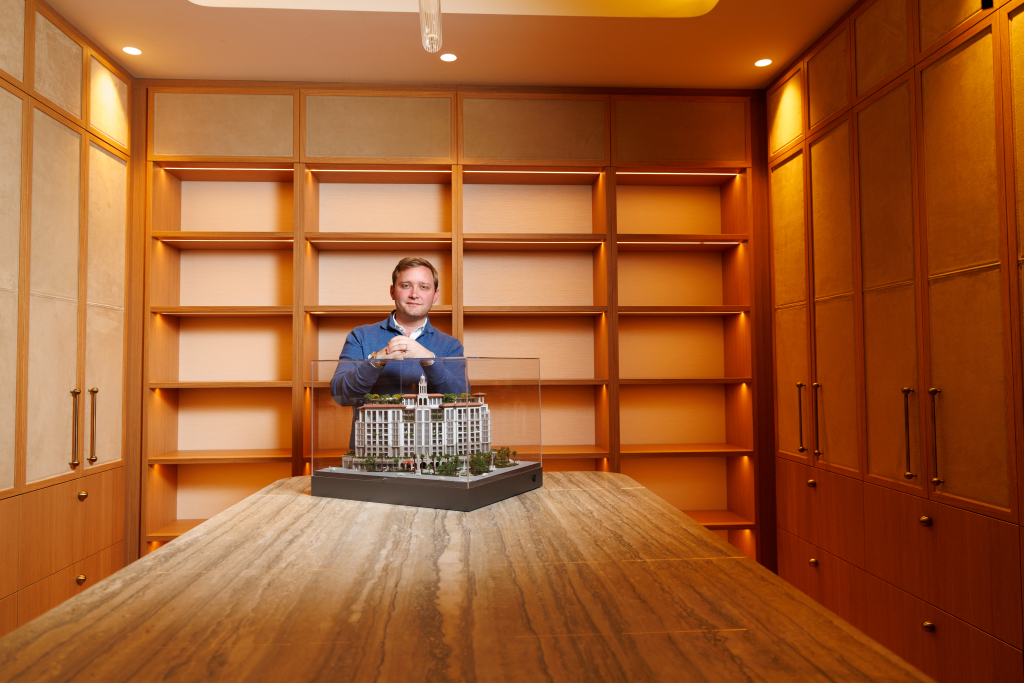
The buyers are overwhelmingly local, says Morris, many of them empty nesters who are selling large homes nearby but want to keep their primary home in the city. The floor-to-ceiling glass walls of each unit look across the green residential areas of historic Coral Gables. “They just want to live more flexibly,” says Morris, which means having lock-and-leave convenience without sacrificing space (average size: 3,000-square-feet) or their local anchor.
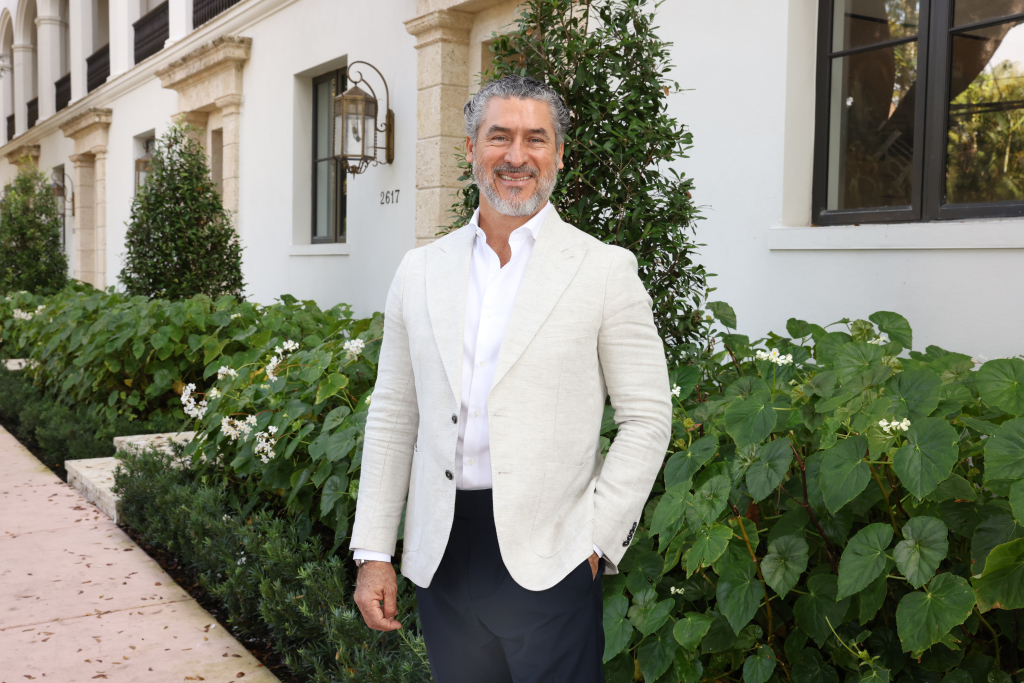
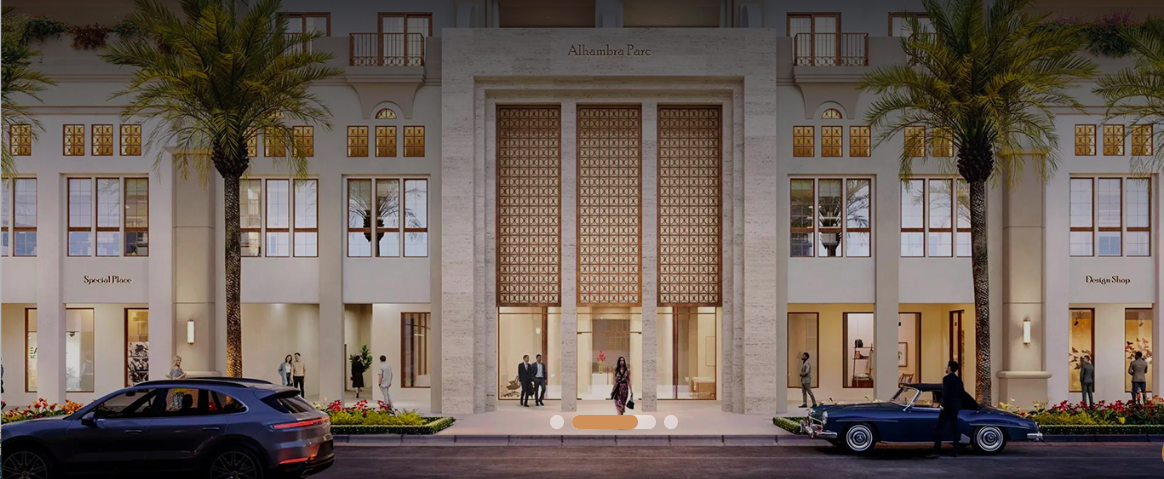
On the other side of the downtown, also promising walking distance to the city’s cultural core, is Alhambra Parc, a new project by MG Developer, better known for their townhome projects. Located at 33 Alhambra Circle, Alhambra Parc will feature 74 luxury residences, 13,000-square-feet of office space, and nearly 18,000-square-feet of ground-floor retail.
While they are seeing interest from Northeastern buyers looking for a primary or secondary home, “our buyers are predominantly local empty nesters, many of whom are long-time Coral Gables residents looking to downsize without leaving the neighborhood,” says Alirio Torrealba, CEO and president of MG Developer. Residences will range from 860 to 2,800-square-feet, with on-site amenities to include a state-of-the-art gym, executive center, wellness spa with sauna, meditation garden, resident library with bar and lounge, resort-style swimming pool, rooftop kitchens, and a paraiso garden with outdoor cinema.
A SECOND CONDO CYCLE
If Morris and MG represent the ultra-luxury tier, Eduardo Otaola of Constellation Group represents the new middle-to-upper tier emerging around the Merrick Park district.
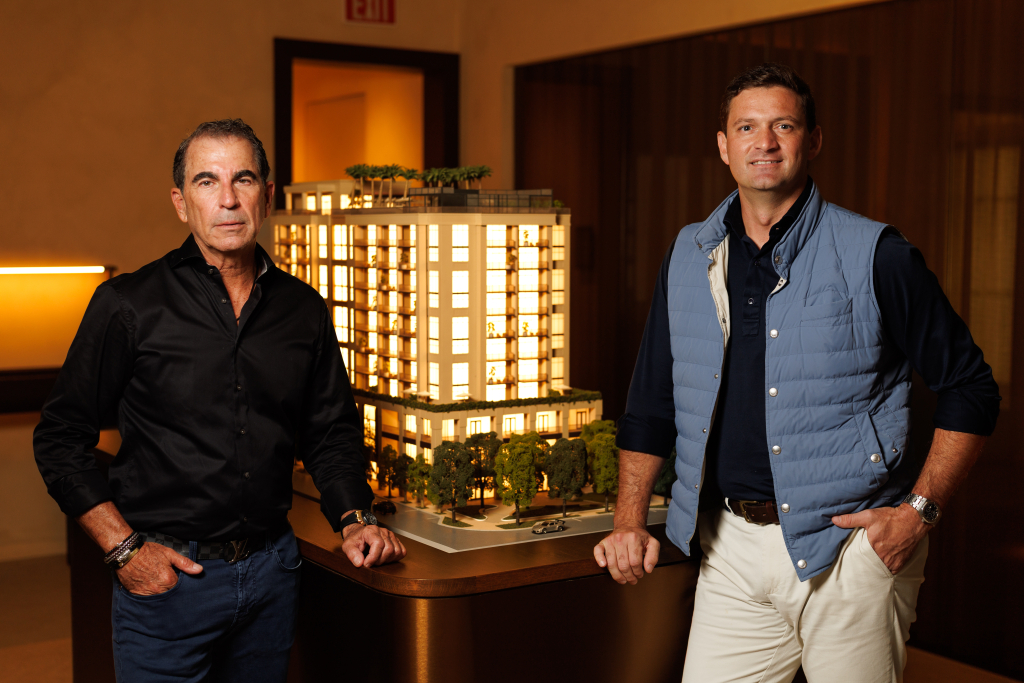
“The last real condo cycle in Coral Gables happened in the early 2000s,” Otaola says. “There was a lot of product that came onto the market – Merrick Manor, 1300 Ponce, you name it – but since then, nothing has been developed except a few here and there, like Villa Valencia and [some] townhomes, but not a lot of condos.”
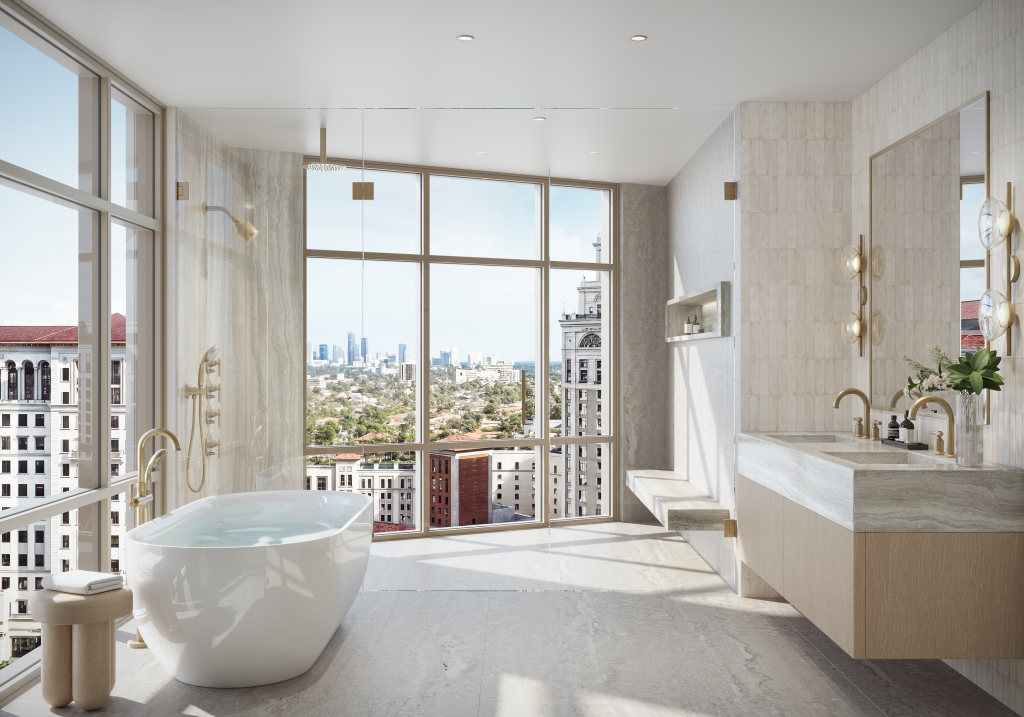
That absence of new buildings created a pent-up demand for the “next generation” of condos in Coral Gables, says Otaola, ones that provide updated amenities, updated finishes, and updated technology. That last item is especially important for Cora, the 13-story, 74-unit project that his company and the Boschetti Group are building adjacent to the Shops at Merrick Park. With the assistance of longevity-design firm Lamarca (run by Otaola’s wife Mayra), Cora will be outfitted with an array of anti-aging and health-span extension technologies, from filtered air and water to electromagnetic room shielding, red light therapy rooms, and infrared saunas. “This is going to be a trend,” Otaola says.
In other words, the second condo cycle is not just about square footage, but about lifestyle and technology. “Today’s new wave of condos in Coral Gables is going to bring a new standard of condo living to Coral Gables,” says Otaola, and that new wave is here. “Right now, you have five new projects in presales today, two of which have broken ground.” In addition to Ponce Park and Alhambra Parc, there are Cora, Cassia, and the Avenue Hotel and Residences, the last three all in the Merrick Park district.
THE RENTAL ALTERNATIVE
When Armando Codina conceived Regency Parc, his new ultra-luxury residential tower in the heart of the downtown, he did so as both developer and buyer. The motivation was both personal and financial.
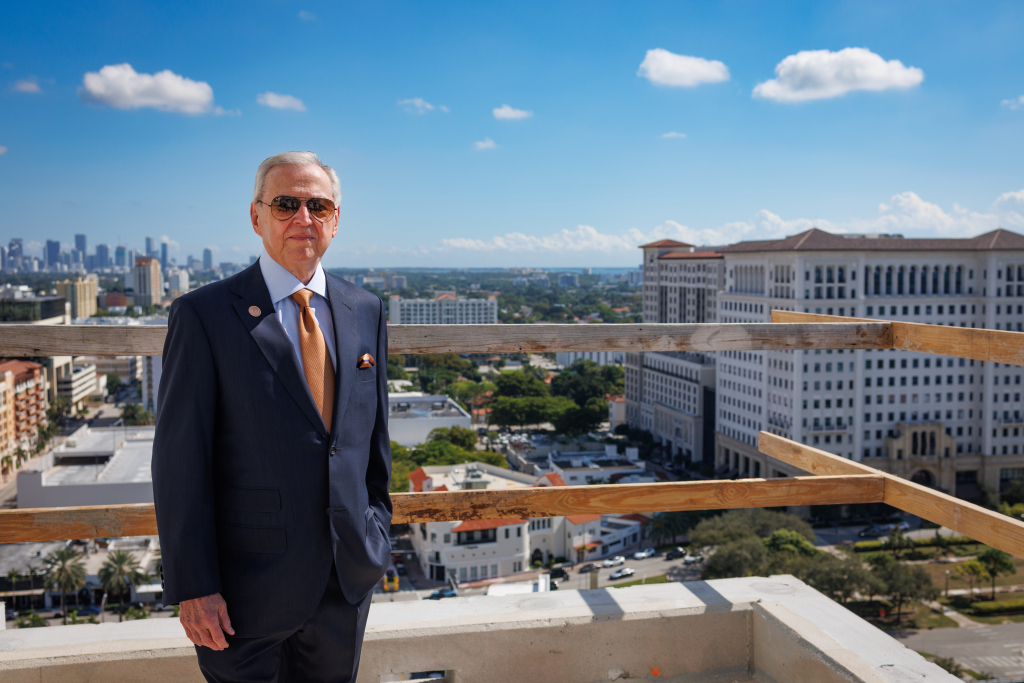
“I wanted to simplify my estate [and] extract the liquidity,” says Codina, who is selling his home in Gables Estates and moving into the top floor of Regency Parc. But unlike other empty nesters looking to downsize, he is not moving into a condominium, but into a super-luxury, long-term lease apartment tower, which he is building in lieu of a condo. “The world has gotten a lot more complicated in the last few years with condominiums, because of the governance,” he says, and he didn’t want to subject himself to those headaches. What Regency Parc will have are all the amenities expected in the second wave of condominiums – high technology that, in this case, will include enhanced security with facial recognition entry, a dedicated telehealth suite, and biohacking recovery pods. There is also a 75-foot rooftop pool, a 15-seat movie theater, and private elevator access to units.
Codina is not alone in his perception that downsizing Gableites may wish to avoid the complications of condo ownership in favor of luxury apartments. Luis Arevalo and his partner David Torres of TA Builders have developed a boutique luxury rental building at 701 Valencia, aimed squarely at downsizers. “When we were conceiving this building… Ron Shuffield gave us the advice,” Arevalo recalls. The conclusion: high-end rentals were the right fit.
“We perceived how the city was going,” says Arevalo. “The market has been evolving drastically the last five years. I would say that right now, even though the lower portion of the residential market is suffering because interest rates are so high and the cost of construction is so high, if you go a little bit to the high end, the market is completely booming…. So, ours is basically a top quality [rental] building for a city that is going in this direction.”
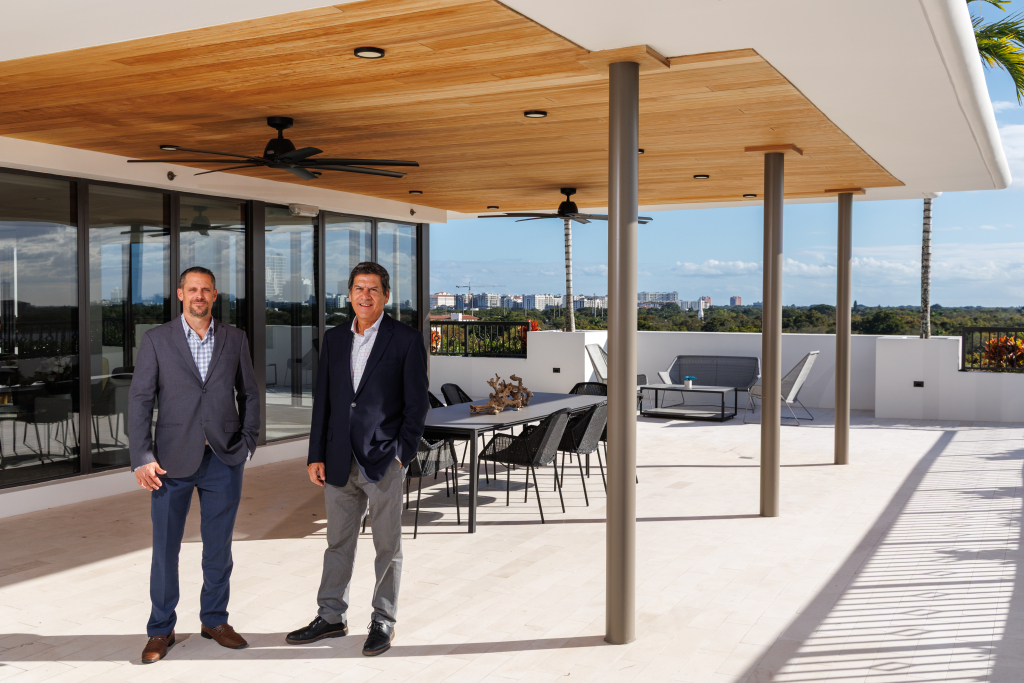
Units – only 25 in the building – rent for between $7,000 and $11,000 per month and include solid-core doors with walnut finishes, spacious layouts (1,300 to 2,700-square-feet), Italian kitchen cabinetry, wine coolers, Miele appliances – “things you don’t usually see in an apartment,” says Torres. Common area perks include a rooftop pool and sundeck, a state-of-the-art fitness center, and an executive business center. Detailed amenities include refrigerator storage in the mailroom for prescription drug deliveries.
Arevalo says most tenants are local, often empty nesters who “don’t really care about owning or managing.”The units are laid out to feel like homes, with solid wood doors, integrated appliances, and balconies. “We’re also the only building in Coral Gables where every single parking space is EV car-charger capable,” says Torres.
Besides developing their own property, TA Builders have taken on many of the condominium and townhome projects in the city, including the current construction of The George, the latest townhome development by MG Developer, directly adjacent to 701 Valencia.
THE CASE FOR THE TOWNHOME
While the first Coral Gables townhomes were built in the early 2000s, the developer most closely associated with this third option for attached housing is Alirio Torrealba, the CEO of MG Developer. His award-winning complex of townhomes just west of downtown – called Biltmore Square – is now reaching completion with the construction of The George. Also nearing completion is a full-square-block townhome compound called The Village at Coral Gables, which he envisions as the seventh of the villages created by George Merrick when the city was born.
“In Coral Gables specifically, demand remains strong for townhomes and thoughtfully scaled condominiums that offer privacy, yet proximity to world-class amenities found in the central business district,” says Torrealba, whose projects are all walkable to the city’s downtown; many have also won awards for their architectural design, principally by Gables-based De La Guardia architecture firm. “Buyers are increasingly focused on well-located projects with the strong architectural identity Coral Gables is known for, as well as efficient floor plans,” he says. “Those fundamentals are translating into consistent sales performance despite a more selective market environment.”
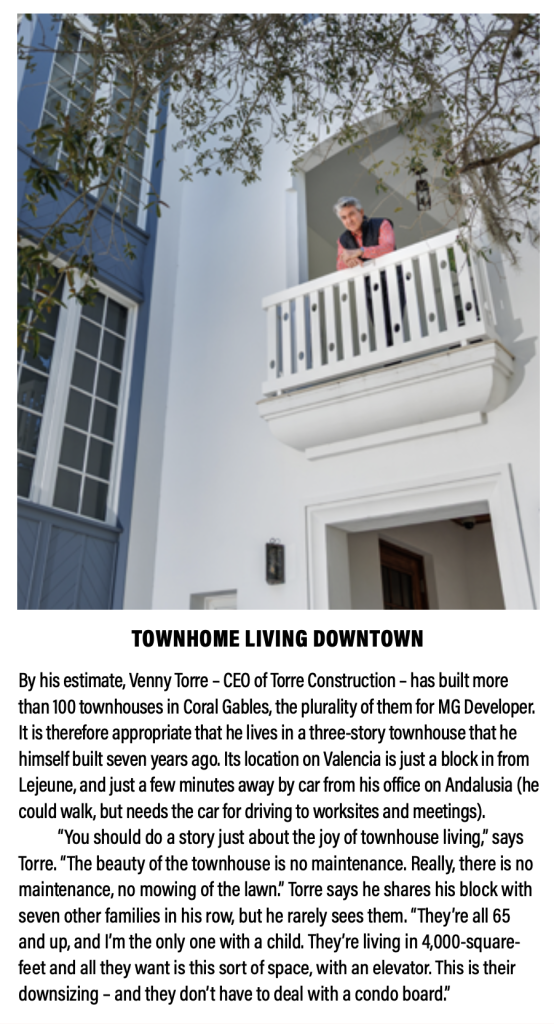
“The beauty of the townhome is no maintenance,” says Venny Torre, of Torre Companies, which has built most of MG Developer’s townhomes. “Unlike condominiums, there is no board drama. No elevator politics. No $5,000 monthly association fees.” In the seven-unit enclave of townhomes where Torre lives, most residents are 65 and older, moving from large homes into 4,000-square-foot townhouses with elevators. “This is how they downsize,” he says.
WHERE IT’S HEADED: A 24/7 DOWNTOWN
Behind all of this is a policy objective. Belkys Perez, head of Coral Gables’ Economic Development Department, sees residential density as essential to downtown vitality. Adding residents turns a “nine to five district into a 24/7 economy,” she says. And with only roughly 3,200 residents downtown today, the city wants more.
“Basically, you’d have a built-in customer base for local businesses. You’d have a more consistent base for restaurants, for retail, for personal services, so you reduce the reliance on office workers and on tourism or special events,” says Perez. “Residential is fundamental for the resiliency of the downtown, because those are the people that support their local businesses.” Perez says she has been stunned by the desolation of some of the downtowns she has visited in recent years for conferences. “You would have thought there was a holiday and that everyone was out. There was no one on the street, and at nighttime, it was even worse. That’s not the type of environment that we want here in the Gables. We want it active day and night.”
The Merrick Park district demonstrates the model, where residential growth there has supported retail and restaurant expansion. The goal is not towers for speculation, but neighborhoods with foot traffic.
SO WHERE DOES THE MARKET GO NEXT?
Even if interest rates remain above six percent, new high-end condominiums and townhomes will continue to attract the affluent buyer who wants to call Coral Gables home – as well as those who already live here and are downsizing from large homes. “Each single-family home here is like a collector’s item,” Shuffield says. And since land is finite and demand global, the Gables attached-home market should remain strong.
New condos will compete in technology, wellness, and resilience. Luxury boutique buildings will sell exclusivity and permanence. High-end rentals will offer flexibility. Townhomes will offer autonomy without a condo board. For aging homeowners sitting on millions of dollars in equity, the question may not be whether to move – just where. Some will choose the Roman travertine of Ponce Park. Some will choose the biohacking pods of Cora. Some will choose the fortress-like privacy of Regency Parc. Some will quietly slip into an MG townhome and never attend another condo meeting.
The Coral Gables dream is still alive. It just comes with an elevator now.