

A Village Between Two Worlds
|
Getting your Trinity Audio player ready...
|
Revisiting Coral Gables’ Chinese Village
By Boyuan Zhang (in collaboration with Karelia Martinez Carbonell)
What first drew me to Coral Gables was not Florida, but China. For years, my research has focused on the work of Henry Killam Murphy, an American architect who devoted his career to reviving traditional Chinese architecture. Murphy built extensively throughout China in the early 20th century, but only one example of his Chinese-style architecture was ever realized in the U.S.: the Chinese Village in Coral Gables. So, when I received an invitation to speak at the Village’s centennial celebration, I immediately said “yes.”
Traveling from New York, where my architectural practice is based, I kept thinking about Murphy making a similar trip a century ago. In 1926, he most likely boarded the newly opened Orange Blossom Special, carrying his drawings and watercolor renderings for the developer’s review. The commission had come from George Merrick’s team the year before, at a moment when Murphy was already deeply established in China. By then, he had spent more than a decade designing Chinese college campuses and institutional buildings, places like Yale-in-China in Changsha, Ginling College in Nanjing, and Yenching University in Beijing, translating traditional Chinese architectural forms into modern steel-and-concrete construction. Operat- ing between offices in New York and Shanghai, Murphy maintained a truly international practice long before the age of globalization.
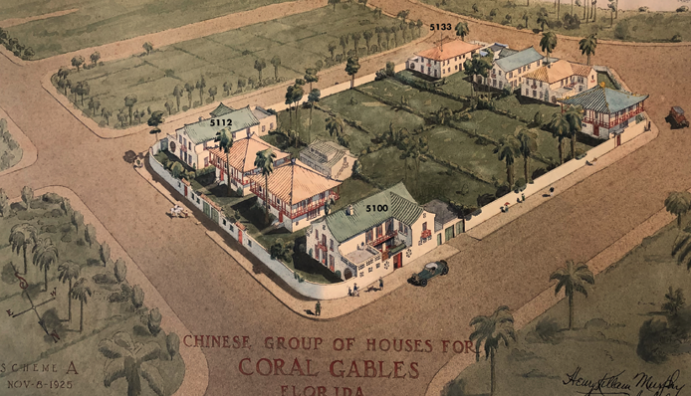
From archival drawings and correspondence, I came to appreciate the sophistication of Murphy’s approach. He devised two primary house types – square and L-shaped – both organized around spacious living areas and modern amenities. Murphy never treated Chinese architecture as surface decoration. He employed historical precedents with precision and thoughtfulness, integrating them into a cohesive architectural composition. The result is neither imitation nor fantasy, but something more original: American houses shaped through a Chinese architectural sensibility.
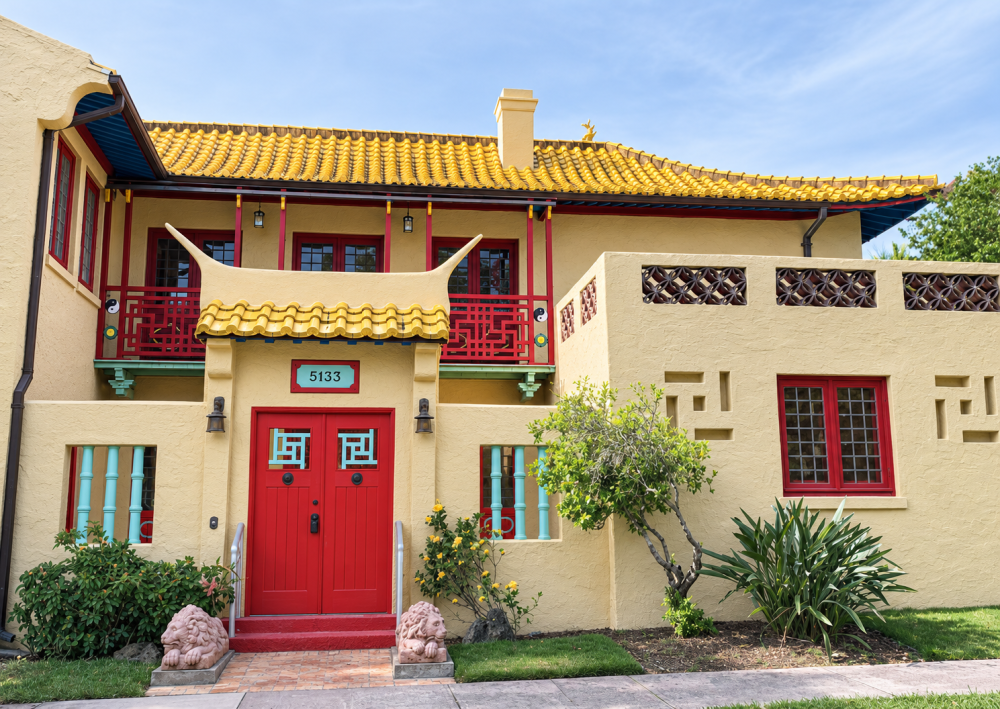
Murphy’s urbanism was well suited to the Gables. Joined by continuous garden walls, the houses form a unified streetscape of covered gates, pierced bamboo windows, and gracefully curved roofs. The extraordinary colors, paying homage to traditional Chinese polychromy, stand vividly against the Floridian sky and lush vegetation. Joining other projects such as the French and Italian villages, the Chinese Village expanded George Merrick’s broader vision for Coral Gables as a city comprising unique and variegated architectural elements.
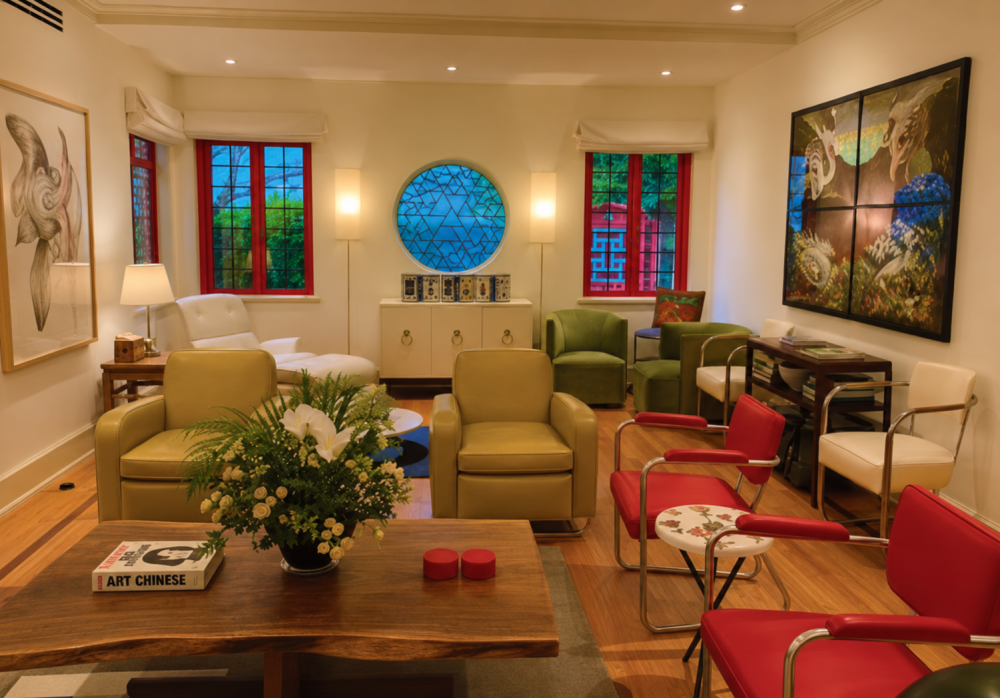
The event itself was hosted in the beautiful living room of one of the historic houses, with residents, architects, preservationists, scholars, and civic leaders gathered not simply to hear me speak, but to engage in genuine exchanges. We discussed ideas of domesticity, the relationship between architecture and landscape, and how cultures borrow from one another to create something richer. What moved me most was how people spoke about the places they grew up in, the streets they loved, and the towns they had visited across the world. It reminded me that architecture ultimately matters because it shapes daily life.
Soon after the Chinese Village was completed in 1926, the devastating Miami hurricane and the collapse of the Florida land boom brought financial hardship to Murphy’s firm, just as it did to all of Coral Gables. Murphy would continue designing some of modern China’s most important national monuments – including the master plan for the new Republican capital of Nanjing – but Coral Gables remains the only record of his transpacific vision on American soil.
A Rare Afternoon in the Village
The 1926 Chinese Village – a unique compound of eight homes on Riviera Drive between Sansovino and Castania avenues – turns 100 this year. The Chinese Village was commissioned by George Merrick and designed by Yale architect Henry Killam Murphy. The
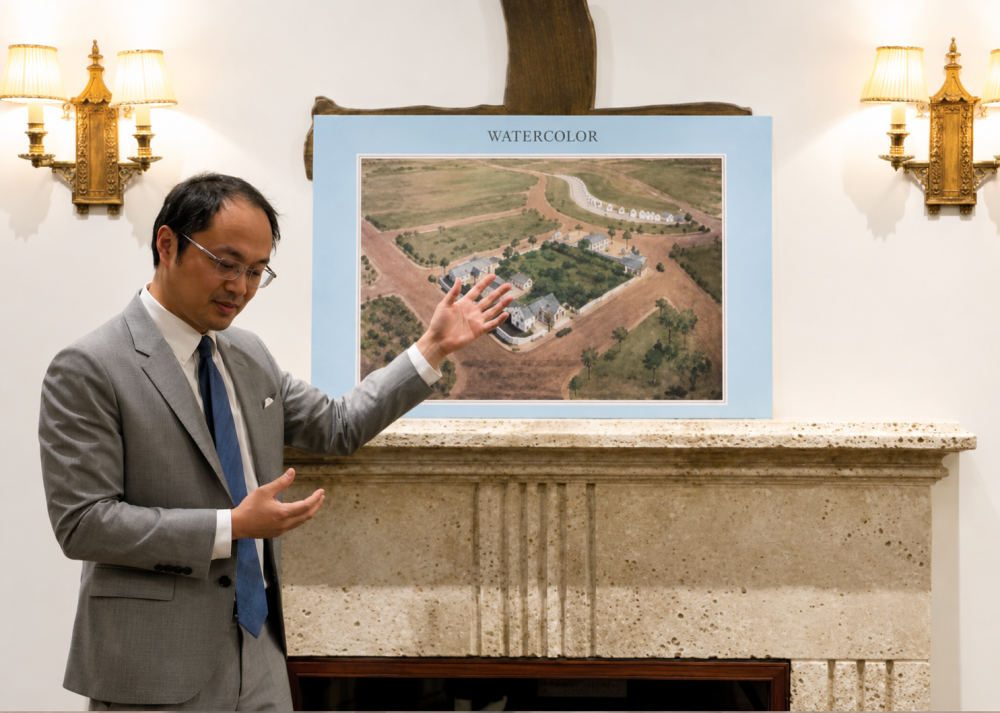
Historic Preservation Association of Coral Gables hosted a Cham- pagne Soirée fundraiser to benefit historic preservation in cele- bration of the Village’s centennial.
The event featured a lecture by guest of honor Mr. Boyuan Zhang, AIA, a Senior Associate at Robert A. M. Stern Architects in New York and the foremost expert on Murphy’s work. Zhang holds graduate degrees from both Yale and Tsinghua University and is a Henry Killam Murphy Scholar. His published research on the Chinese Village is considered the definitive account.