
The Locals at Beaux Arts
|
Getting your Trinity Audio player ready...
|
In Its 75th year, Beaux Arts draws both local and International artist alike
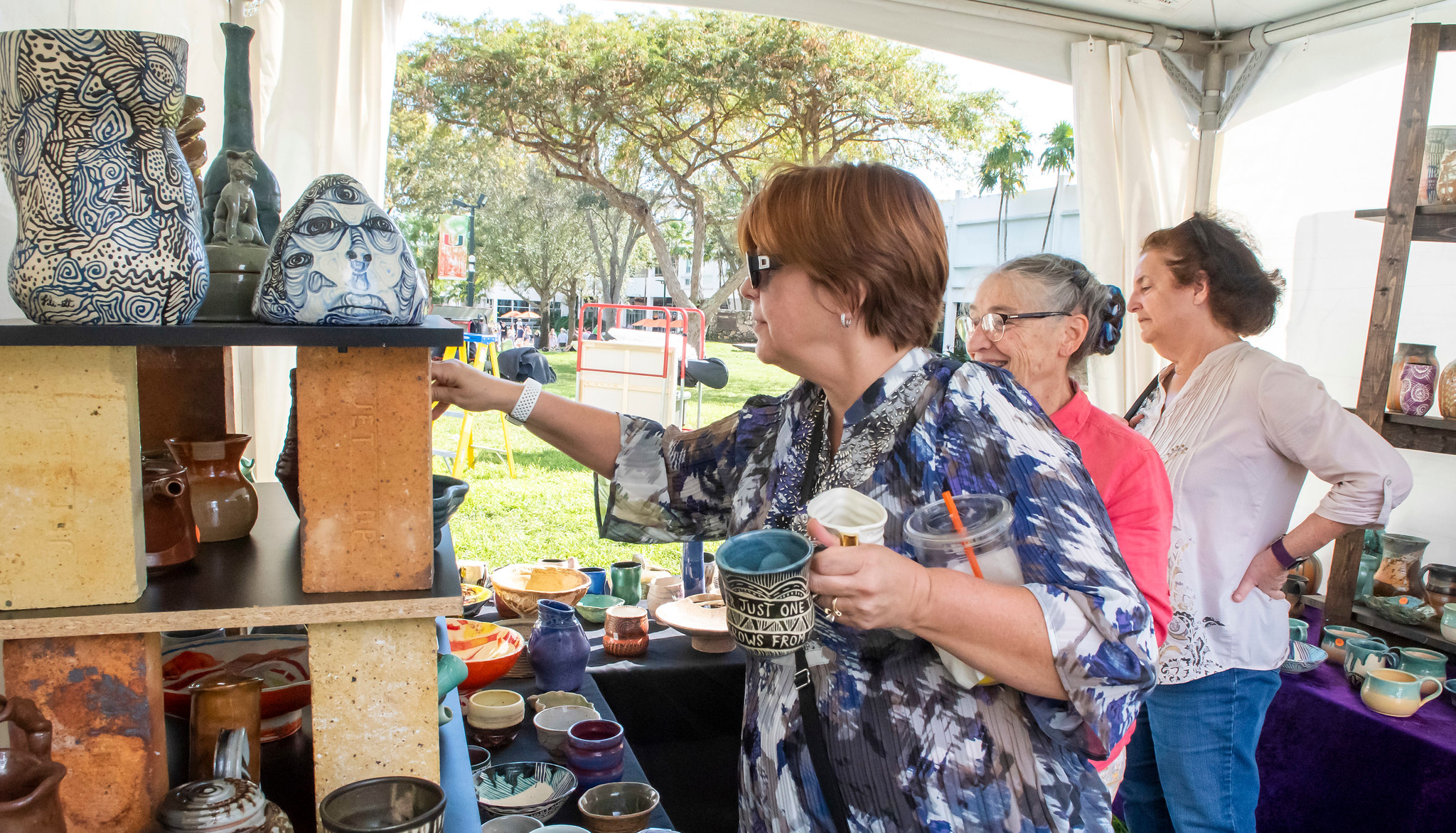
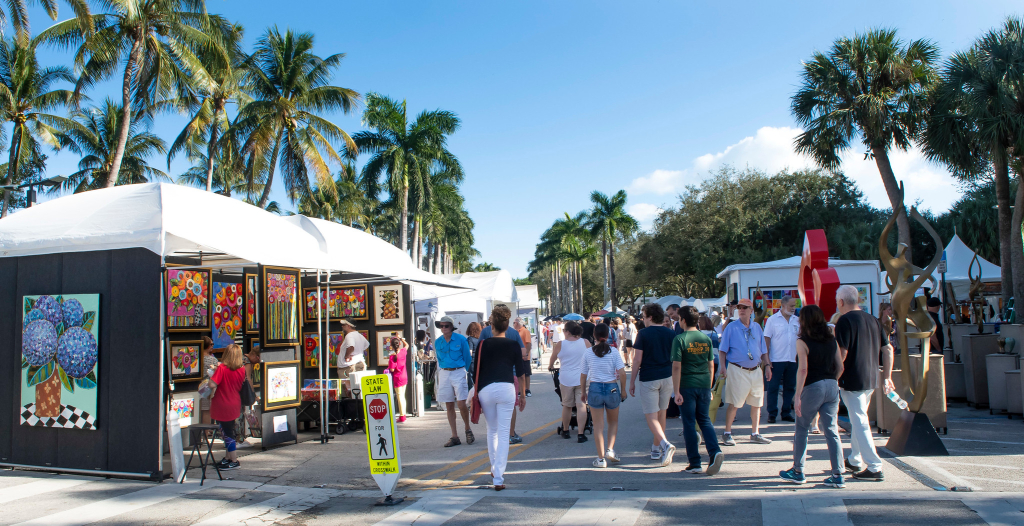
Each January, Coral Gables’ art scene bursts to life with the Beaux Arts Festival of Art, a much-loved cultural tradition and one of South Florida’s most distinguished art events. Founded in 1952 as the humble “Clothesline Sale,” where local artists displayed works along lines strung up beside the Lowe Art Museum, the festival has blossomed into Miami’s longest-running juried art festival, drawing more than 25,000 visitors to the University of Miami’s campus every year. Admission is free and open to the public, inviting art lovers of all ages to wander between more than 200 juried exhibitors showcasing fine art in mediums ranging from painting and photography to ceramics, glass, and sculpture.
Julio Roberto
Painting
“My art is simply there for someone to look at, smile, and have a positive, joyful reaction…”
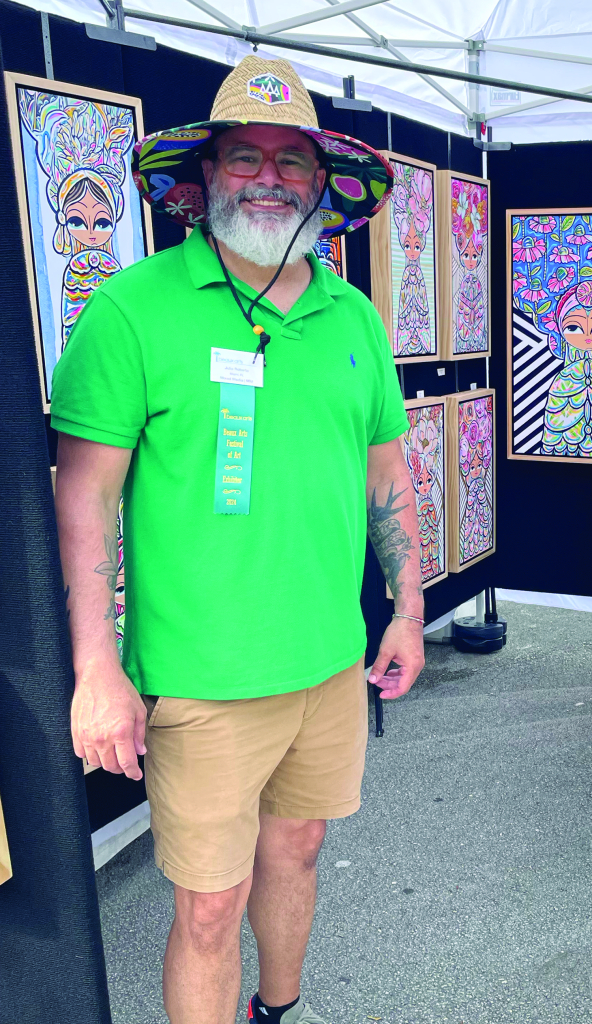
As a social worker with the AIDS Healthcare Foundation, Julio Roberto understandably needs a cathartic way to de-stress. That’s come to him in the form of painting, a practice he took up in 2018 “as a therapy, so to speak,” he says. Perhaps it’s Roberto’s work with persons living with HIV and AIDS that informs his art, which he says “tends to make people happy. In a world that’s so fractured, it’s what I’ve always wanted my art to do.” He pushes back on the notion that art has to be a reflection of the artist’s personal turmoil. “My art is simply there for someone to look at, smile, and have a positive, joyful reaction,” he says. “There’s a lot of expressionist painters that I do love, that were very tortured and tormented, but that’s not what I want to delve into. I want to be a little more superficial in my art and make it about the emotion a person feels when they see the painting.”
Roberto is drawn to art from myriad cultures, including his parents’ native Cuba, though he also enjoys Caribbean art, Eastern European religious motifs, and Brazilian street-style. When he travels, he’s always looking for folk art, “knickknacks and colorful things done by artisans.” He loves Russian nesting dolls, for example, elements of which are present in much of his work.
“Just about every positive role model I’ve had in my life has been female,” Roberto says. “So, when I paint, I tend to put the female there, I tend to make her very important, usually dressed in something royal.” In many of his pieces, the women also have intricate headdresses or hair, embroidered with painted motifs of leaves, stripes, and various shapes in starkly vivid colors. He also makes the frames for each work himself, using solid pine wood.
“I had a difficult childhood, so [painting] was something that I needed,” Roberto says. Now in his seventh year exhibiting at Beaux Art, that still holds true. The former Spanish-speaking child who grew up in Little Havana is now older, wiser, and has found a true calling in the rainbow mélange of his work.
Michael Frommer
Painting, Foam Sculpture
“What’s the story behind this? well, i have my idea, but i bet you’ve got one as well, and i bet yours is better…”
Art found Michael Frommer in an interesting way: his dyslexia diagnosis. “History and languages were very difficult for me,” Frommer says of his high school self. “I gravitated toward art because it was visual.” That led to art school, where he studied graphic communication, which led to a job right out of college at a big-name Chicago advertising agency. “I worked on big clients: Kleenex, Raid, United Airlines, Kentucky Fried Chicken, things like that,” says Frommer. “But at night… I started painting.”
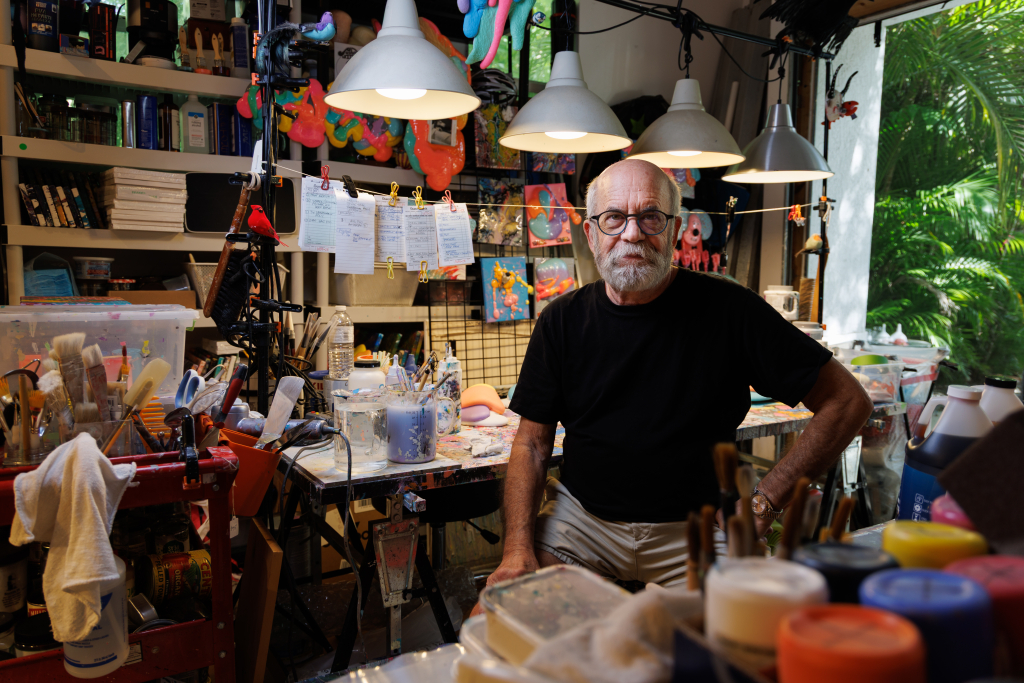
Though painting was his first love, Frommer is also interested in a very different form of art: foam sculpture. He’s a regular at Home Depot, which sells the liquids he uses, combining them to create foam insulation that he then makes art out of. “The paintings I’ve done take a long time. They’re complex; it usually takes two or three weeks,” says Frommer. “But the foam stuff was just so immediate.” The brightly colored sculptures mimic everything from raining clouds to lush lagoons, even incorporating photo frames and candles. The whimsical pieces, as well as his paintings, are products of Frommer’s love for storytelling. “People ask, ‘What’s the story behind this?’ And my response is usually, ‘Well, I have my idea, but I bet you’ve got one as well, and I bet yours is better,’” says Frommer.
His paintings may include politicians (one particular standout, “Mao,” features the controversial Chinese leader seemingly waving at the viewer as a scantily clad woman and a man with a clown nose zoom across a lake on a levitating broomstick) and political issues (he has a whole series entitled “Climate Change”), but Frommer denies any intentional political messaging. Asked about his artistic philosophy, he replies with a mysterious smile, “My uncle is sick, but the highway is green.”
Though this will only be Frommer’s second year at Beaux Arts, he says he aims to be a regularly returning artist, praising the festival for its “high level of showmanship” and the quality of its artists.
Jacqueline Roch
Painting
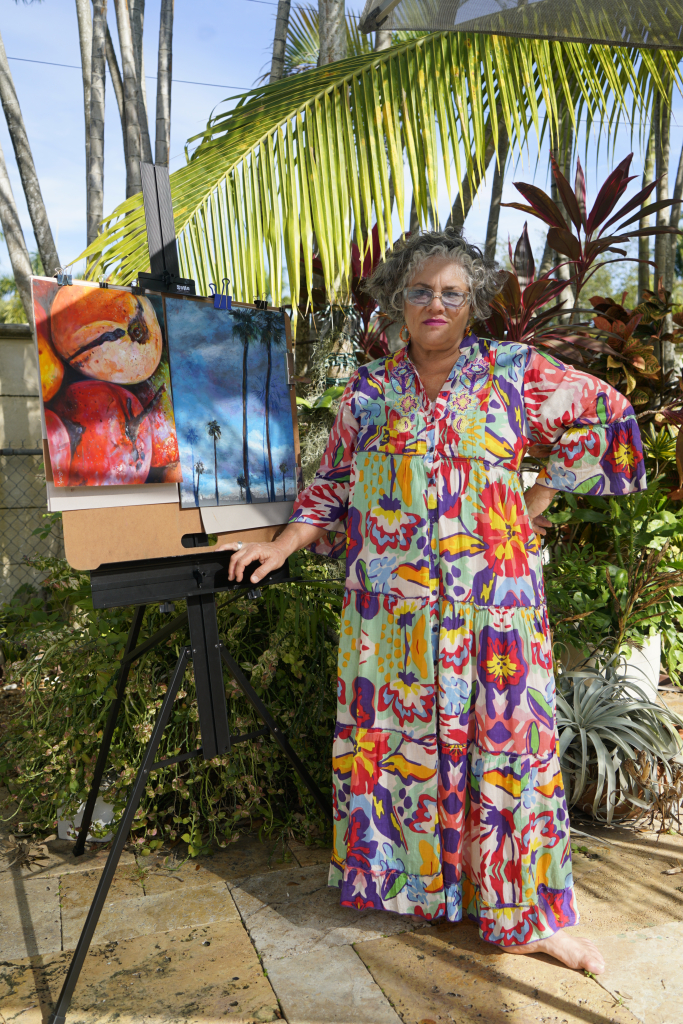
“The biggest struggle I always faced when I was much younger was what to do with my talent…”
My very first show was Beaux Arts in January of 1998,” says Jacqueline Roch, reminiscing fondly on close to three decades of exhibitions. At the time, Roch was the art teacher at Coral Gables Elementary (now Coral Gables Prep). It was her students’ mothers that encouraged her to apply for the prestigious festival. Her work earned her a first-place prize, and “that’s how it all began,” she says.
Roch is about as local as it gets in Miami. Growing up in Miami Beach, she would take a school bus once a week to Charles R. Drew Elementary in Liberty City, where 20 students from across the county would assemble for a special art program. “I did that all the way through high school, and then I got my BFA in graphic design and moved to New York City,” says Roch. “I thought I needed to have a real job even though I wanted to be a fine artist.” But it wasn’t long after that when Miami – with its sun and sand and sea that inspires so much of her work – called her back home.
“I draw inspiration from everything South Florida!” Roch says. She refers to her style of work as “tropical realism,” depicting orchids, mangoes, seashells, mangroves, and more, in vivid hues with soft pastels on sanded paper. “Layering the pastels allows me to create very vibrant, vivid pieces,” she says. “I love color and pastels are just that: pigment [that doesn’t] fade; the purest of Mediums.”
With 28 years of making art and exhibiting it at shows, Roch has achieved the self-assurance of a veteran artist. “The biggest struggle I always faced when I was much younger was what to do with my talent,” she says. “I would feel guilty for not having more abstract or political work.” Now, she’s done trying to be something she’s not. “I got selfish, making art that I like and that I want to share. I want it to be beautiful, and I want you to feel that momentary nugget of joy.”
Armando Colls
Photography
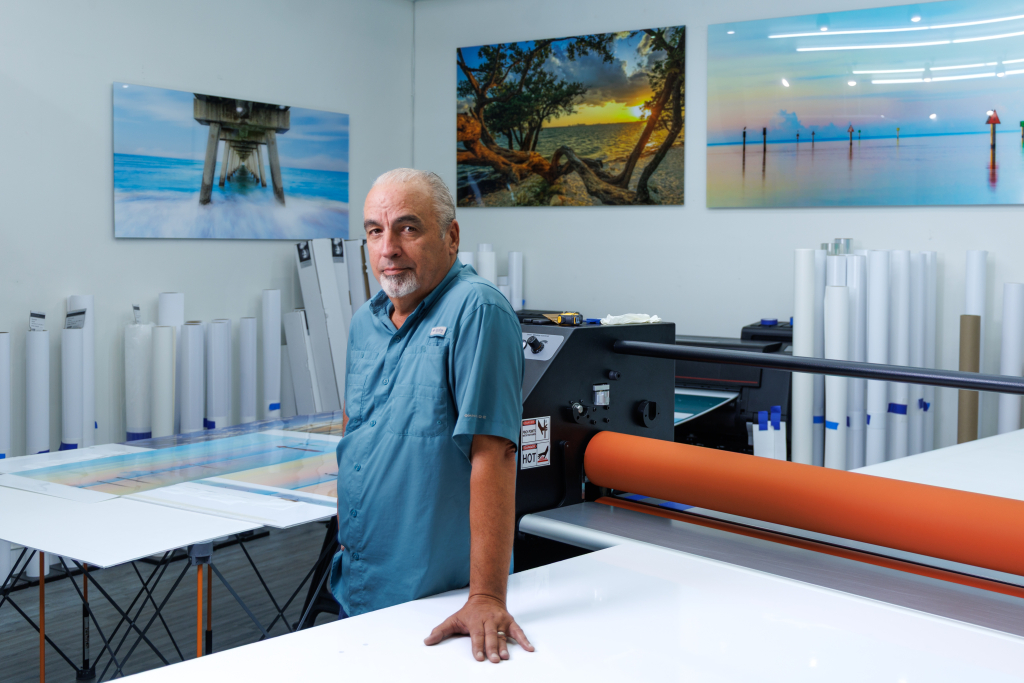
“All my work, to me, is very emotional. when i sell a piece, it’s like one of my kids is leaving the house…”
Twelve years ago, Armando Colls borrowed a camera from a friend so he could take some nice photographs of his car. It was a spur of the moment decision that changed his life. “I was hooked,” he says simply. Soon, he was waking up early to shoot sunrises and finding reasons to get outside in the afternoon to photograph the sunset. “It became a hobby, and then it became a passion,” says Colls.
His landscape and still-life photography soon developed into a career, showcasing his pieces at art shows throughout South Florida. He’s been exhibiting at Beaux Arts for nearly a decade, earning several first and second place prizes in the photography category. Most of his work is inspired by nature, especially the waters of South Florida, where he grew up fishing, diving, and boating. “All my work, to me, is very emotional,” says Colls. “When I sell a piece, it’s like one of my kids is leaving the house.”
Often, Colls will revisit a spot 20, 30, or even 100 times to get the perfect shot. Then, he texts his family and they decide on a name together. Despite the rigorous process, he finds peace in his work – and hopes others do too. “I shoot very minimalistic,” he says. “I don’t shoot a lot of clutter. [I may be] surrounded by clutter, but I pick that one little space where it’s just tranquility and peace and serenity. I hope people find that in my work. I’m always humbled when that translates.”
Surprisingly, Colls describes himself as “not an emotional person,” though he acknowledges that has changed more and more since beginning his photography career. Speaking about a particularly emotional moment – the sale of a piece he entitled “Hope”, which went to a couple who had recently lost their son to cancer – he tears up. “That still holds,” he says, “and that was probably more than three or four years ago.”
Talking about lighter topics, he adds, “I don’t think I’m an artist. It’s just very rewarding, that interaction between my work and that person for the first time. It’s very emotional to me.”
James Hilton
Graphic design, Screenprinting
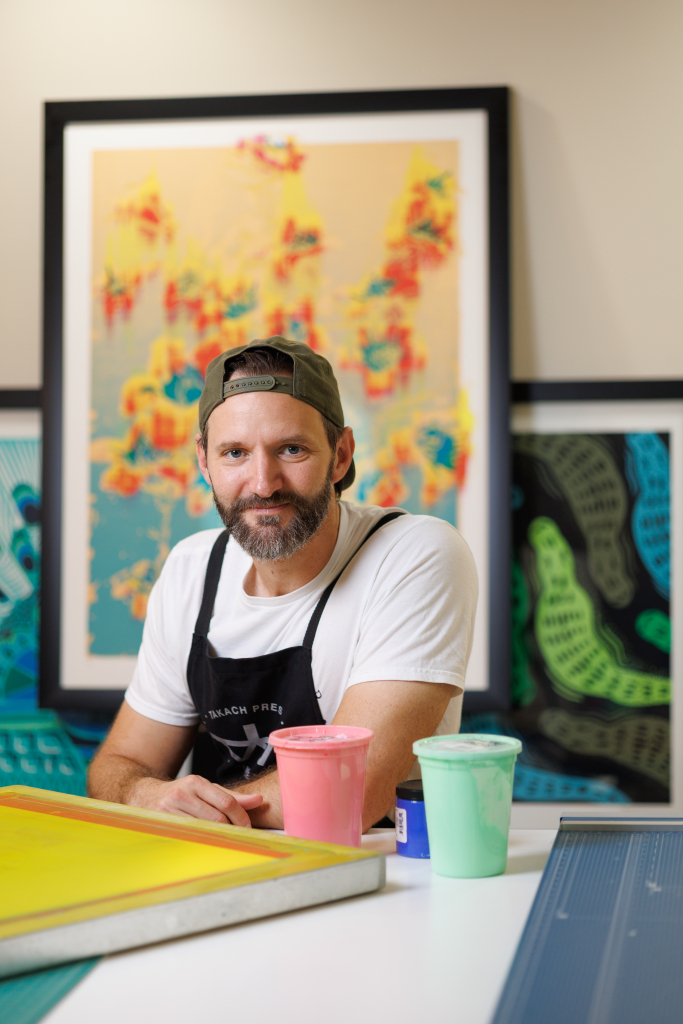
“It was like, ‘okay, this is going to be a fun thing i can do on the side and maybe sell a few…”
Born to musician parents in London, England, James Hilton grew up in “a creative household” where artistry was encouraged and a “proper job” wasn’t considered necessary for success. He studied fashion design in college, which is when he was first introduced to screen-printing – though it took him about 25 years to fully realize just how much he loved the art form.
A long career in the fashion world brought Hilton to the United States in 2017, where he climbed the corporate ladder in Boston. But something was missing. “The job had taken me away from being a handson creative, [and] I wanted to get back in touch with that because I really missed it,” Hilton says. He enrolled in a continuing education course at the Massachusetts College of Art and Design, which taught screen-printing, as a way to both pursue his passion and meet other burgeoning artists.
Then, COVID hit. Hilton and his wife ended up in Miami after pandemic-era layoffs forced them to move. With nothing else to do until he could get a new work visa, Hilton began a screen-printing studio called 22nd of Never. His colorful works, somewhat out of place in Boston, were perfect for the Miami art scene, incorporating pop art and Art Deco elements into Florida- inspired pieces. Motifs of flamingoes, alligators, and manatees, alongside classic cars and maps of Coral Gables and Miami Beach (amongst other neighborhoods) quickly pushed Hilton into the art fair scene. “People liked it so much,” he says. “It was like, ‘Okay, this is going to be a fun thing I can do on the side and maybe sell a few.’ But then we were selling a lot.”
Now a full-time artist, Hilton has won numerous awards around the nation, including a prestigious printmaking award from the Coconut Grove Art Festival. This year will mark his fourth time participating in Beaux Arts Festival, which has recently added its own printmaking awards category – another accolade Hilton hopes to add to his resume. “It’s a very supportive city, a very supportive community,” says Hilton of Coral Gables and Beaux Arts. “The team may change every year, but they’ve always been really receptive, really into what we’re doing.”
Read more of our past coverage of the Beaux Arts Festival of Art.